
Destination: Asia
Good Morning, Vietnam!
by Jim Benning | 01.19.02 | 1:52 AM ET
R. Scott Moxley was sound asleep at 6 a.m. when he got the wake-up call from one of Vietnam’s thousands of blaring, moralizing loudspeakers. “People here say the Communists’ real message is: we’re watching you, so stay in line and keep your trap shut,” he writes in this week’s OC Weekly.
 Email to friend
 del.icio.us
 Digg
Digg Facebook
 Furl
Furl Ma.gnolia
 Mixx
Mixx Reddit
 StumbleUpon
 Yahoo! Buzz
“Let’s Have a Butcher’s”
by Michael Yessis | 01.19.02 | 1:50 AM ET
The International Herald Tribune’s Roger Collis explores the differences between British and American English, as well as Australian, Canadian and Indian usage.
“Sales of Guidebooks to Afghanistan Have Not Been Strong”
by Jim Benning | 01.12.02 | 2:30 AM ET
The latest edition of the New York Review of Books features a story by Tim Judah about his recent travels in Afghanistan. “Sales of guidebooks to Afghanistan have not been strong during the last two decades, so the bookshop in Kabul’s Intercontinental Hotel (no running water on most floors, and bring your own sleeping bag) still has plenty of copies of Nancy Hatch Dupree’s 1977 Afghanistan left on its shelves,” he writes. “It is perhaps the most extraordinary guide I have ever read.” In the same issue, Ian Buruma, author of the analytical Asia travel narrative God’s Dust, among other books, offers a historical perspective on Occidentalism, September 11 and anti-modernization movements. “There is no clash of civilizations,” he writes. “Most religions, especially monotheistic ones, have the capacity to harbor the anti-Western position.”
The Filipina Sisterhood
by Michael Yessis | 01.11.02 | 2:32 AM ET
The Economist examines the lives of Filipina amahs, the “domestic helpers” who often live in virtual slavery to Hong Kong’s elite. “[T]hose who should be Hong Kong’s most miserable are, by all appearances, its happiest. How?”
Travels in Afghanistan
by Michael Yessis | 01.09.02 | 2:36 AM ET
A Los Angeles Times columnist recalls travel writing about Afghanistan, including Bruce Chatwin’s 1980 short essay, “A Lament for Afghanistan.”
Welcome to North Korea. No Spitting! No Flower Picking!
by Jim Benning | 12.30.01 | 11:43 PM ET
South Korean tourists allowed into tightly controlled North Korea are treated to a long list of rules and regulations, little interaction with locals and, oh yes, a welcome ceremony that features a Filipino band performing “California Dreaming.” A Los Angeles Times article highlights just how political travel can be.
Gonzo Dispatches from the Front
by Jim Benning | 12.29.01 | 11:57 PM ET
A pair of twenty-something American travelers who apparently entered war-ravaged Afghanistan are filing dispatches on their website. They’re either courageous or crazy or both. Whichever, their Tora Bora tales and angst-ridden musings offer a unique perspective on the devastated nation, as well as the media covering it. “We are here to see what it’s all about for ourselves, with our own eyes; unmediated by camera lens or agenda,” they write. “We maintain this site because most of you will die soon without any idea of what any of this is like beyond your paranoia and fear as fostered by the assumed reality of your television.” Their journey has been covered in several newspapers, including the Los Angeles Times.
Chasing Monks
by Maria Möller | 12.28.01 | 11:51 PM ET
The Rise of the Brand State: The Postmodern Politics of Image and Reputation
by Michael Yessis | 11.02.01 | 8:37 PM ET
That’s the actual headline of a story in Foreign Affairs magazine. It’s a piece that may change the way you look at the countries you visit—and the country you’re from. “Look at the covers of the brochures in any travel agency and you will see the various ways in which countries present themselves on the world’s mental map,” Peter van Ham’s story begins. “Singapore has a smiling, beautiful face offering us tasty appetizers on an airplane, whereas Ireland is a windy, green island full of freckled, red-haired children. But do these images depict real places, existing geographical sites one can visit? Or do the advertisements simply use cultural stereotypes to sell a product?” Interesting questions, both. Van Ham has no concrete answers, but he explores them with depth and insight.
Checking In: Americans Living Abroad
by Michael Yessis | 10.29.01 | 8:39 PM ET
The New York Times tracks down U.S. residents in Italy, France, Saudi Arabia, Japan, Indonesia, Mexico and other countries to find out how lives of ex-pats have changed in the six weeks since the terrorist attacks. Some anecdotes sound like benevolent urban legends: “Most Americans in Saudi Arabia live on enclosed compounds…At one recent dinner the conversation inevitably turned to security concerns. The couples traded stories, like the one about two Americans whose car broke down on a stretch of desert highway. They were immediately wary of two Saudi men who stopped to offer help. Sensing their unease, one Saudi turned to the Americans and said, ‘By the way, we hate Osama bin Laden.’ ” Other stories are a bit creepy and, possibly, paranoid: “Not long ago, [24-year-old English teacher Gabrielle Parnes] said, she was with two girlfriends [in Paris], giggling and talking loudly when a group of Arab-looking men walked by and purposely elbowed each of them. ‘I can’t be sure they knew we were American,’ she said. ‘But I think so. Before I might have thought they were just nasty guys. But now I can’t help thinking it was because we were American.’”
“I Saw Campbell’s Soup Being Eaten Straight From the Can on a Porch in Elk Grove Village”
by Michael Yessis | 10.24.01 | 8:46 PM ET
Aleksandar Hemon came to the United States from Sarajevo in the winter of 1992 to participate in a cultural-exchange program. He arrived with a love for American pop culture. “I fantasized about starting a band whose first album cover would be designed by Andy Warhol,” he writes in the October 15 issue of The New Yorker. “I imitated Holden Caulfield’s diction (in translation), and I manipulated my unwitting father into buying me a Charles Bukowski book for my seventeenth birthday.” The end of his trip coincided with the beginning of the war in Bosnia. Hemon stayed in the U.S., landing a job in suburban Chicago canvassing for Greenpeace. For two and a half years he went door-to-door, and his experiences form the backbone of an essay worth a trip the library (New Yorker archives are not available online). “After a while, my view of American culture changed,” he writes. “I began to understand the meaning of the Talking Heads’ songs, the anarchic pretentiousness of Altman’s movies…and the magnitude of America’s defeat in Vietnam.”
A Time of Living Dangerously?
by Chuck Newman, Chris Dickson | 10.18.01 | 12:55 AM ET
Stories of unrest in Jakarta run almost daily on CNN and BBC. Chuck Newman and Chris Dickson, however, aren't yet ready to flee.
The Razor’s Edge
by Leigh Webber | 10.09.01 | 12:57 AM ET
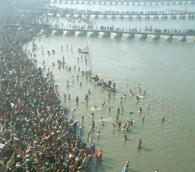 Photo by Leigh Webber.
 All along the Ganges, India's holiest river, pilgrims offer their hair to the gods. Leigh Webber joins them and contemplates her (former) blondness.
Sorrow in the Land of Smiles
by Jim Benning | 09.27.01 | 1:00 AM ET

On the streets of Bangkok Jim Benning faces a confounding reaction to the terrorist attack on America
In the Wake of September 11
by Michael Yessis | 09.19.01 | 9:01 PM ET
Several readers have passed along links to stories regarding the tragedy in the U.S. We’d like to share:
>> Dave McKenna writes in the Washington CityPaper about attending a soccer game in Rome just after the World Trade Towers were toppled.
>> New York Times writers Jane Fritsch and David Rohde follow the paper trail from the offices, tracking down the owners of resumes, bank records and cell phone statements that floated across the city and as far away as Brooklyn.
>> Sonya Ross of the Associated Press takes readers aboard Air Force One for U.S. President George W. Bush’s post-attack journey from Florida to Louisiana to Nebraska to Washington D.C.
>> In the International Herald Tribune, Roger Collis examines travel in the coming weeks, months and years.
>> In the New York Times, Anthony DePalma writes of his cross-country odyssey from San Diego to Newark in a rental car.
>> CNN’s Nic Robertson fled Afghanistan September 19. He writes about his last week there.