
Destination: Europe
No. 4: “The Soccer War” by Ryszard Kapuściński
by Frank Bures | 05.28.06 | 8:34 PM ET
To mark our five-year anniversary, we’re counting down the top 30 travel books of all time, adding a new title each day this month.
Published: 1978
Territory covered: Africa, Central America, Cyprus and Israel
 Email to friend
 del.icio.us
 Digg
Digg Facebook
 Furl
Furl Ma.gnolia
 Mixx
Mixx Reddit
 StumbleUpon
 Yahoo! Buzz
No. 9: “The Innocents Abroad” by Mark Twain
by Michael Yessis | 05.23.06 | 9:32 PM ET
To mark our five-year anniversary, we’re counting down the top 30 travel books of all time, adding a new title each day this month.
Published: 1869
Territory covered: Europe and the Holy Land
Mark Twain’s The Innocents Abroad marks a turning point for both the author and American travel writing. In 1867, Twain boarded the ship the Quaker City for a five-month Journey through Europe and the Holy Land, and he convinced the Daily Alta California, a San Francisco newspaper, to pay him $1,250 to file letters from abroad for publication. He sent 51, and those, along with a few others written for newspapers in New York, comprise “Innocents Abroad.” The dispatches, followed by lectures he delivered based on his travels, helped establish Twain’s voice as an American original. During Twain’s lifetime, “Innocents” was his most popular book, and today it remains perhaps the most celebrated travel book by an American writer. Some critics credit its longevity to its fresh approach: It was written from a different angle than most travel books of its time. As Twain writes in the preface:
World Cup Fans: Do You Know What Your Country Smells Like?
by Michael Yessis | 05.23.06 | 1:09 PM ET
Coca-Cola? Ripe mangoes? A piña colada? An After Eight mint? Chanel No 5? According to the Telegraph, retired perfume maker Ernst-Adolf Hinrichs of Holzminden, Germany, has identified the scents of the countries competing in next month’s World Cup tournament. Kate Connolly writes that Holzminden is “home to one of the world’s leading industrial producers of smells,” and that Hinrichs has created the scents for “smelling posts” around the city. Visitors are instructed to, of course, “follow their noses.” So which of the scents listed above belong to which country?
Brits to French: You’re Unfriendly, Ungenerous and Boring
by Michael Yessis | 05.23.06 | 7:12 AM ET
So say 6,000 voters surveyed by the travel site Where Are You Now, according to an AFP report. Germans finished second in all of the same categories. Respondents in the survey ranked countries in various categories, including most cultured and most unstylish. The “winners” respectively: Italy and the United States.
Report: Passenger on Virgin Atlantic Flight Had Ebola Virus
by Michael Yessis | 05.21.06 | 4:41 PM ET
The Mirror reports that a 38-year-old passenger on a flight from Johannesburg to London suffered a “violent fit” and subsequently died from the deadly Ebola virus. “Virgin Atlantic cabin crew who came into contact with the woman have been told to monitor their health,” writes Stephen Moyes. “One said: ‘We are now terrified what we may have caught.’”
No. 14: “Riding to the Tigris” by Freya Stark
by Frank Bures | 05.18.06 | 12:17 PM ET
To mark our five-year anniversary, we’re counting down the top 30 travel books of all time, adding a new title each day this month.
Published: 1959
Territory covered: Turkey
More than halfway through her 100 years on earth, Freya Stark, the “poet of travel,” headed alone on horseback across the Turkish plateaus to the Tigris River. By that time she had been traveling for decades, mostly in the Middle East, where she had learned Arabic as well as French, Latin, German, Italian and Persian. For her Turkish travels, she threw in Turkish. Stark always stayed in places long enough to write with an insider’s knowledge of a culture. Stark believed in the power of travel and of its capacity to open minds. She once wrote that, “Only with long experience and the opening of his wares on many beaches where his language is not spoken, will the merchant come to know the worth of what he carries.” Stark, who thought the world was divided into two kinds of people, the settled and the nomad, and who climbed Annapurna at 86, was fearless in her traveling. Early on, she abandoned the restrictions of her era for her love of the horizon, which she called “the eternal invitation to the spirit of man.” And while the collection, “Journey’s Echo,” might be a better introduction to her overall work, Riding to the Tigris is one of her finest and most reflective books.
Kurt Andersen on Denmark’s “Touristic Outliers”
by Michael Yessis | 05.18.06 | 12:05 PM ET
Legendary magazine editor and Turn of the Century author Kurt Andersen has a piece in the May issue of Travel + Leisure on Denmark. It’s a journey into the cultural fringes of a place popularly thought of as “sensible, reasonable, healthy, tidy, virtuous, nice.”
No. 15: “Europe, Europe” by Hans Magnus Enzensberger
by Frank Bures | 05.17.06 | 5:50 PM ET
To mark our five-year anniversary, we’re counting down the top 30 travel books of all time, adding a new title each day this month.
Published: 1989
Territory covered: Sweden, Italy, Hungary, Portugal, Poland, Spain, Germany, Holland, Finland, Romania
Once upon a time, Europe was fascinating. There was much more to the continent than the endless pension and immigration debates we hear so much about today. In Europe, Europe: Forays into a Continent, Hans Magnus Enzensberger captured some of that old fascinating place. His book is filled with the rich, complicated, maddening, exhilarating patchwork of cultures that have mixed and clashed on the continent for thousands of years. Visiting just before the fall of communism, Enzensberger was concerned with politics, but mainly as a window into culture. He explored and skewered national character without reverting to stereotypes. In fact, he investigated stereotypes, turned them inside out, and made them at once amusing and insightful. Enzensberger has a gift for this, and for identifying minutiae that make even the most boring country in the world (Sweden) riveting. “Europe, Europe” is one of the few books written about the continent before the fall of communism that remains as relevant, vibrant and hilarious as when it was first published. What’s more, it’s one of the best travel books written about Europe in any era.
Trouble in the Paris Travel Blogosphere?
by Jim Benning | 05.09.06 | 10:40 AM ET
It seems some aren’t too happy with Los Angeles Times travel writer Susan Spano’s ongoing blog from Paris. While I find Spano’s newspaper columns to be a cut above most material in newspaper travel sections—we link to them occasionally here—I’ve never found her blog to be terribly compelling. I don’t often read it. Kevin Roderick at LA Observed sums up the recent flap, which centers on a remark Spano made in her blog next to a photo of tents provided for the homeless along the Seine.
No. 24: “Trieste and the Meaning of Nowhere” by Jan Morris
by Michael Shapiro | 05.08.06 | 8:50 AM ET
To mark our five-year anniversary, we’re counting down the top 30 travel books of all time, adding a new title each day this month.
Published: 2001
Territory covered: Trieste, Italy (and Jan Morris’ imagination)
A student at a writing seminar once asked Welsh author Jan Morris when she planned on writing her autobiography. She smiled and said that every one of her books about place was autobiographical, none more so than her “final” book, written on the eve of the millennium, Trieste and the Meaning of Nowhere. Morris said that she saw herself in Trieste, in its melancholy and moodiness, and its isolation. Once a major port city in the Austro-Hungarian empire, Trieste in the 20th century, as a consequence of war, became part of Italy. But some 70 percent of Italians aren’t aware that its a part of their country, according to a 1999 poll. It’s this sense of displacement that resonates with Morris, born James Morris to a Welsh father and English mother. Morris never felt at home in her male body and culminated her transition to a woman in Casablanca in the early 1970s. She has traveled the world for half a century, enraptured by great cities and penning classic works about them. Morris visited Trieste as a soldier at the end of World War II. Revisiting in the 1990s, she sees in Trieste, which sounds much like the Italian word for sadness, the ideal city on which to project her memories, hopes, and disillusionments. She comes across an open-air concert in a piazza where a few hundred Trieste elders are assembled. “They were singing their own songs, in their own language, out of their own past,” she writes. “I noticed that some of their eyes were full of tears, and I almost wept a little myself: because of their age, because of mine, because of the hard times they had lived through…because of the sweet songs, because I feared nobody would be singing them much longer…and because—well, because of the Trieste effect.” Ultimately, Morris evokes hiraeth, the Welsh idea of longing for something but not knowing what. But “Trieste and the Meaning of Nowhere” is far from depressing. It sparkles with insights and universal truths, always infused with Morris’s trademark charm, more like a wink than a smile. And as she does in every city, Morris finds hope, and cause for celebration.
No. 25: “A Time of Gifts” by Patrick Leigh Fermor
by Tom Swick | 05.07.06 | 1:04 PM ET
To mark our five-year anniversary, we’re counting down the top 30 travel books of all time, adding a new title each day this month.
Published: 1977
Territory covered: Europe
This is a glorious feast, the account of a walk in 1934 from the Hook of Holland to what was then Constantinople. The 18-year-old Fermor began by sleeping in barns but, after meeting some landowners early on, got occasional introductions to castles. So he experienced life from both sides, and with all the senses, absorbing everything: flora and fauna, art and architecture, geography, clothing, music, foods, religions, languages. Writing the book decades after the fact, in a baroque style that is always rigorous, never flowery, he was able to inject historical depth while still retaining the feeling of boyish enthusiasm and boundless curiosity.
This is the first of a still uncompleted trilogy; the second volume, “Between the Woods and the Water,” takes him through Hungary and Romania; together they capture better than any books I know the remedial, intoxicating joy of travel.
Study Travel Writing off the Turkish Coast
by Jim Benning | 05.06.06 | 12:35 PM ET
Travelers’ Tales Executive Editor Larry Habegger will be leading a narrative writing workshop on a yacht off Turkey this June—what a gig, what a classroom. Travelers’ Tales has details.
Hippies Gone? Yes. Inaccessible Via EasyJet? Yup. Welcome to the Latest Hipster Travel Destination.
by Michael Yessis | 05.04.06 | 7:00 PM ET
For the hipster, travel is merely an accessory. “The exclusivity of his cultural and geographical selection defines his personality, in much the same way that the suit he wears, the wristwatch he brandishes, or the car he drives defines him,” writes Simon Mills in an amusing story in the Guardian. Mills examines how a place becomes a hipster destination, and just how slippery that title can be in an age when information travels fast. He also gets inside a hipster traveler’s head and riffs.
On German Travelers, Goethe, Reisefieber and Wanderlust
by Jim Benning | 05.02.06 | 1:13 PM ET
Thomas Swick celebrates German travelers—“The world’s greatest travelers,” declares his column’s headline—in Sunday’s South Florida Sun-Sentinel. The urge to wander runs deep in the culture, he writes. “German, in fact, even has a word for the heightened anticipation one feels before a trip: reisefieber. Like knowing English has no word for putsch, it is a small linguistic jetway into national character.” Don’t miss the last line of the column—a terrific quote.
How to Eat the Cake of Kings in Austria
by Pam Mandel | 04.26.06 | 10:45 PM ET
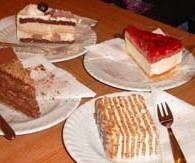 Photo by Pam Mandel.
 In Austria, home of history's biggest proponent of cake eating, Marie Antoinette, the ubiquitous sweet has evolved into a grand tradition. Pam Mandel dishes on making the most of kaffee und kuchen.