
Destination: North America
Swallowing Fear in San Miguel de Allende
by Kristin Van Tassel | 09.16.12 | 5:12 PM ET
 iStockPhoto
 Kristin Van Tassel's ideal window for learning a foreign language closed over 30 years ago. Is there still time?
 Email to friend
 del.icio.us
 Digg
Digg Facebook
 Furl
Furl Ma.gnolia
 Mixx
Mixx Reddit
 StumbleUpon
 Yahoo! Buzz
A Visitor’s Guide to ‘Infinite Boston’
by Eva Holland | 08.10.12 | 9:37 AM ET
Calling all “Infinite Jest” tourists: This blog has you covered. (Via The Millions)
The Sociology of Greyhound Buses
by Eva Holland | 08.10.12 | 8:03 AM ET
Talk about legwork. Yale University PhD student Esther Kim spent two years criss-crossing the USA by Greyhound, studying the ways in which people create the illusion of solitude or privacy while crammed together in a public space. The Atlantic Cities has some highlights from her findings:
Kim says we distance ourselves from others by putting on a “calculated social performance” that lets strangers in a shared public space know that we don’t want to be bothered. This behavior is intended to keep us safe and undisturbed in an “otherwise uncertain social space.” ...Once passengers acquired a seat they began their performance to dissuade potential row partners. They avoided eye contact, stretched their legs to cover the open space, placed a bag on the empty seat, sat on the aisle and blast earphones, pretended to sleep, looked at the window blankly. They also contorted their expressions into the “don’t bother me” face or the “hate stare,” writes Kim.
Of course, we’ve all done these things—I’m a master of the fake nap with one leg stuck out into the empty space, myself—but it’s still interesting to see the same behaviors documented time and time again. I guess it’s a small, slightly anti-social world after all?
Team USA, Mapped
by Eva Holland | 08.09.12 | 10:42 AM ET
Where do Olympic athletes come from? As London 2012 winds down, The Atlantic Cities has an answer. Urban trend watcher Richard Florida mapped the 500+ members of Team USA, first by hometown and then by current residence. Here’s Florida on the hometown results:
The largest number - 9 percent (43 athletes) - are from Los Angeles; 3.6 percent (17) are from the Bay Area, 3 percent (14) are from greater New York; and 2.3 percent (11) from Dallas. Four metros claim ten athletes each (2 percent): Tampa, San Diego, Atlanta and Miami.
Smaller metros rise to the top when we control for population. Now, Rochester, New York, leads the way with 1.7 athletes per 100,000 people followed by Great Falls (1.2), Cheyenne (1.1), Fairbanks (1.0), and Boulder (1.0).
Big northern cities like Chicago and Boston are conspicuously absent from the top rankings. Don’t worry, Chicagoans and Bostonians—you can just take a page out of the Canadian playbook, and blame it on the weather.
R.I.P. Chavela Vargas
by Jim Benning | 08.07.12 | 12:39 AM ET
The singer who recorded countless classic Mexican rancheras during her long career died in Cuernavaca, Mexico, last night at the age of 93.
Like a number of Americans, I suspect, I fell in love with her deep, husky voice the moment I heard her rendition of “La Llorona” in Julie Taymor’s 2002 Frida Kahlo biopic, “Frida.” That was my gateway ranchera to others she recorded, like this one.
Writer Daniel Hernandez has been tweeting from Plaza Garibaldi in Mexico City tonight, where people gathered to remember Vargas. “A couple thousand people just sang ‘Volver’ at once behind Eugenia Leon like it was one big therapy session,” he wrote. “Overwhelming. Only in Mexico.”
Here’s Vargas singing “La Llorona”:
A Jim Crow Road Trip
by Eva Holland | 07.25.12 | 9:45 AM ET
Over at The Root, Nsenga K. Burton looks back at “The Negro Motorist Green Book,” a segregation-era guidebook for black travelers in America. It was first published in 1936, and, writes Burton, it “listed businesses and places of interest such as nightclubs, beauty salons, barbershops, gas stations and garages that catered to black road-trippers. For almost three decades, travelers could request (for just 10 cents’ postage) and receive a guide from Green.”
Burton tried to track down some of the places listed in the guide and found some still going strong. Lovers of guidebook nostalgia (we’re looking at you, Doug Mack) should check out the full story.
Taco Bell’s Big Alaskan Airlift
by Eva Holland | 07.15.12 | 7:00 PM ET
Last month, when I heard that residents of Bethel, Alaska, had been tricked—by a still-anonymous hoax-ster—into believing a Taco Bell franchise was coming to town, I felt a serious twinge of sympathy for my fellow Northerners. Sure, sites like Gawker had a field day with the story (“Parents looked in from bedroom doorways on their sleeping children and smiled,” they wrote at the time. “A silent prayer of thanks that sons and daughters would never know a life devoid of local fast food offerings.”) but it’s easy to snark when you’re sitting in an office in lower Manhattan, with your every heart’s desire just the swish of an iPhone away.
Geographical isolation produces strange cravings, and things that seem pedestrian, elsewhere, take on a bizarre importance. Here in Whitehorse, Canada, we’re counting down to the return of our KFC and Dairy Queen franchises—both closed several years ago—and even the healthiest of health nuts can’t wait for the grand re-openings. It’s about the injection of something new, something—anything—different into a well-worn routine. In that way, I suppose you can compare the arrival of a fast food franchise in a remote small town to the act of travel itself: Good or bad, it always shakes things up.
Anyway, Bethel’s story ends happily. Taco Bell airlifted 10,000 Doritos Locos Tacos into town to soothe the sting of the hoax, and the end result of the whole saga is this promo spot:
Still Listening
by Catherine Buni | 07.13.12 | 10:28 AM ET
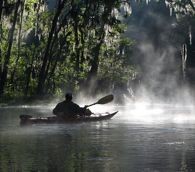
On New Hampshire's Androscoggin River, Catherine Buni tried to draw her paddling partners into conversation. But her questions only got her so far.
New Documentary: ‘Neil Young Journeys’
by Jim Benning | 07.07.12 | 4:22 PM ET
Jonathan Demme’s third documentary about Neil Young, in select theaters now, features a solo performance Young gave at Toronto’s Massey Hall and footage of Young driving across the Ontario countryside, musing about life and his childhood.
‘Get Out of the Damn Car’: An Illustrated Death Valley Road Trip
by Eva Holland | 06.20.12 | 2:49 PM ET
Over at Afar, illustrator Wendy MacNaughton has recreated a brief road trip from San Francisco to Death Valley and back. The drawings include fun headings like “Public Bathroom Ratings” and “Things That Can Be Seen From a Car Window.” I dug it. (Via @The_Rumpus)
Moby on Los Angeles Architecture
by Jim Benning | 06.05.12 | 9:56 AM ET
People who’ve spent much time in Los Angeles know the city is home to some amazing architecture—classic mid-century designs, rustic Craftsman homes, bizarro medieval castles—and that these places are often tucked away in canyons, or behind tall fences, or in nondescript suburbs.
The musician Moby is now living in L.A., and he was so impressed by this that four months ago he launched a blog about it featuring his photographs and observations. It’s a good read. This short video offers an intro to L.A. architecture and his perspective on it:
26 ‘Chinatown Bus’ Operators Shut Down
by Eva Holland | 06.01.12 | 10:09 AM ET
A few years back, we posted news that the cheap and occasionally safety-challenged Chinatown buses—cult favorites among budget travelers in the Northeastern U.S.—were reportedly cleaning up their act. Turns out the effort fell short. After a year-long investigation, federal safety officials have closed down 26 carriers operating in the busy Northeast corridor—16 based in New York, and 10 in Philadelphia.
So R.I.P. Chinatown buses. But never fear, budget travelers—BoltBus is still kicking.
Not Your Usual Spring-Break-in-Florida Story
by Eva Holland | 05.17.12 | 12:42 PM ET
This essay from the NYT, about Alessandra Stanley’s mother-daughter vacation, is causing a stir—no huge surprise, I suppose, when it starts with a line like this: “One of the good things about divorce is that you get to see less of your children.” Stanley and her daughter spent a less-than-idyllic spring break at a super-luxury resort on a private island near South Beach. Here’s a taste:
I imagined sunrise walks on the beach, giggly mother-daughter spa treatments and intimate candlelit meals during which Emma would lean in and at long last tell me what college was like besides “fine.”
I failed to anticipate that exam-rattled 18-year-olds sleep long past noon and then stay up all night (I get up around 6 and am asleep easily before 10). Nor had I known that embedded in the ethos of this particular private island is a class system that places short-term guests below the salt.
Refreshingly honest? Privileged and self-indulgent? The Times commenters are weighing in bare-knuckled. (Via Ta-Nehisi Coates)
Paul Theroux on ‘Multilayered and Maddening’ Hawaii
by Jim Benning | 05.14.12 | 10:43 AM ET
Paul Theroux lives in Hawaii but finds aspects of the archipelago’s culture to be mysterious and nearly impenetrable. When he set out to talk with natives about local traditions, he was met with silence and monosyllabic replies, even when he turned up with gifts of honey from his own bees.
I had never in my traveling or writing life come across people so unwilling to share their experiences. Here I was living in a place most people thought of as Happyland, when in fact it was an archipelago with a social structure that was more complex than any I had ever encountered—beyond Asiatic. One conclusion I reached was that in Hawaii, unlike any other place I had written about, people believed that their personal stories were their own, not to be shared, certainly not to be retold by someone else. Virtually everywhere else people were eager to share their stories, and their candor and hospitality had made it possible for me to live my life as a travel writer.
(Via @nerdseyeview)
Video: Luis Alberto Urrea on the U.S.-Mexico Border
by Jim Benning | 05.09.12 | 12:22 PM ET
Luis Alberto Urrea has written a number of great books—fiction and non-fiction such as “The Devil’s Highway”—about the U.S.-Mexico border and life in the two countries. He appeared on Moyers & Company recently, where he discussed migrant deaths, book-banning in Tucson, growing up in Tijuana and a San Diego suburb, and a range of related topics. Great stuff. Here’s the hour-long show: