
The Iditarod: Worth the Work It Takes to Follow It
Travel Blog • Jenna Schnuer • 02.26.09 | 1:13 PM ET
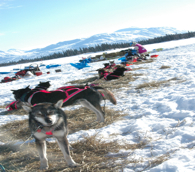 Musher DeeDee Jonrowe’s team, 2006. Photo by Jenna Schnuer.
For spectators, dog mushing is a hard sport. There’s no loop de loop on a race track. There’s no back and forth on a court. Once the dogs go by…they’re pretty much gone. Dog mushing as spectator sport takes patience, dedication, and a lot of reading (internet and newspaper updates of days-long races are key). But just one dose of a race, one chance to watch it in person, to see the connection between the mushers and the dogs and, quite simply, you’re sunk. It gets in you.
I fell for it in 2006 when I went up to Alaska to do a story about the Iditarod. Really, I didn’t think dog mushing would become an obsession. I figured it’d be an interesting thing to check out and then I would be done with it. I thought it was just another piece of Alaska that I should see. Instead, my interest in the sport keeps growing. It all stems from the connection between the mushers and their teams. We should all be so lucky to have bonds that strong with another living creature. I’m not sure I’ve ever even really seen that between two people. They have to trust each other. The mushers and the dogs know it. I know some will say I’m romanticizing the whole thing; I don’t care—I saw it.
Here’s the moment that got me over and over: as the teams readied to leave the checkpoint, the dogs would go completely hyper. Some would pogo up and down, many would start to pull, almost all would holler and whine. Then, when the checkpoint referee gave the go and the musher gave the “hike” command, the dogs would quiet and, all at once, just start pulling. The only sound coming from the sled runners as it slid on by. It was the most beautiful quiet.
So, you in? The 2009 Iditarod starts March 7. That gives you one week to study up and choose your favorite musher. And then I’ll see you out here.
 Email to friend
 Twitter
 del.icio.us
 Digg
Digg Facebook
 Furl
Furl Ma.gnolia
 Mixx
Mixx Reddit
 StumbleUpon
 Yahoo! Buzz
Freelancer Jenna Schnuer writes about travel, food, culture, books, and life's quirky bits (and bites) for publications including American Way, National Geographic Traveler, Southern Living, and many others. She also co-writes Flyover America, a site filled with quieter stories from around the U.S. Send Jenna an email or, if you're so inclined, follow her on Twitter.

Margery Glickman 02.26.09 | 4:52 PM ET
For the dogs, the Iditarod is a bottomless pit of suffering. What happens to the dogs during the Iditarod includes death, paralysis, frostbite (where it hurts the most!), bleeding ulcers, bloody diarrhea, lung damage, pneumonia, ruptured discs, viral diseases, broken bones, torn muscles and tendons and sprains. At least 136 dogs have died in the race. No one knows how many dogs die after this tortuous ordeal or during training. For more facts about the Iditarod, visit the Sled Dog Action Coalition website, http://www.helpsleddogs.org .
On average, 53 percent of the dogs who start the race do not make it across
the finish line. According to a report published in the American Journal of
Respiratory and Critical Care Medicine, of those who do finish, 81 percent have
lung damage. A report published in the Journal of Veterinary Internal Medicine
said that 61 percent of the dogs who complete the Iditarod have ulcers versus
zero percent pre-race.
Iditarod dog kennels are puppy mills. Mushers breed large numbers of dogs and
routinely kill unwanted ones, including puppies. Many dogs who are
permanently disabled in the Iditarod, or who are unwanted for any reason, including
those who have outlived their usefulness, are killed with a shot to the head,
dragged, drowned or clubbed to death. “Dogs are clubbed with baseball bats and if
they don’t pull are dragged to death in harnesses…..” wrote former Iditarod
dog handler Mike Cranford in an article for Alaska’s Bush Blade Newspaper.
Dog beatings and whippings are common. During the 2007 Iditarod, eyewitnesses
reported that musher Ramy Brooks kicked, punched and beat his dogs with a ski
pole and a chain. Jim Welch says in his book Speed Mushing Manual, “Nagging a
dog team is cruel and ineffective…A training device such as a whip is not
cruel at all but is effective.” “It is a common training device in use among
dog mushers…”
Jon Saraceno wrote in his March 3, 2000 column in USA Today, “He [Colonel Tom
Classen] confirmed dog beatings and far worse. Like starving dogs to maintain
their most advantageous racing weight. Skinning them to make mittens. Or
dragging them to their death.”
During the race, veterinarians do not give the dogs physical exams at every
checkpoint. Mushers speed through many checkpoints, so the dogs get the
briefest visual checks, if that. Instead of pulling sick dogs from the race,
veterinarians frequently give them massive doses of antibiotics to keep them running.
Most Iditarod dogs are forced to live at the end of a chain when they aren’t
hauling people around. It has been reported that dogs who don’t make the main
team are never taken off-chain. Chained dogs have been attacked by wolves,
bears and other animals. Old and arthritic dogs suffer terrible pain in the
blistering cold.
Margery Glickman
Sled Dog Action Coalition, http://www.helpsleddogs.org
Laura 02.28.09 | 11:01 AM ET
I saw the title of this post in my reader and immediately knew I’d have to visit it and leave a comment about the unnecessary cruelty and suffering endured by the dogs of this “sport.” Well, I’m so glad Margery beat me to the punch and summarized the problem of this horrific tradition much more eloquently than I could. Yay, Margery! What she said!
I would like to add that tradition or entertainment are never reasons to continue cruel practices toward ANY creature inhabiting this earth. If this kind of use is considered acceptable for our best friends, we have little hope of ever rethinking our use of animals we have less affection for. The race must end.
Josh 03.02.09 | 12:10 AM ET
ugg - glickman!
Talk about a party pooper - busy bodies from Flordia don’t know anything about dog mushing.
I’d love to be a part of any Iditarod Fan’s coverage of this years’ race…. I’ve been blogging and podcasting the Iditarod for 5 years now at Iditablog.com…. come join in on the conversation.
Claire Walter 03.02.09 | 5:47 PM ET
I share your interest,. I’ve never been in Alaska for the Iditarod but in Anchorage for the sprints (3 consecutive 25-mile races) in in Jackson, WY, for the start of a dogsled race there. Unexpectedly exciting.
Jenna Schnuer 03.04.09 | 3:02 PM ET
Thanks to everybody—both pro and con—for chiming in. I am definitely aware of the concerns Margery and Laura raised and it is something I continue to discuss with people in the sport and to look out for. While I know there are problems within the sport, the vast majority of mushers I’ve talked to and observed (and others involved in the sport) are, first and foremost, concerned with the dogs. But, I promise, I will keep an eye on the things you discussed and continue to ask people about those issues.
On a lighter note: This past weekend, I finally had the chance to—for a very short stretch—drive a dog sled. The chance to spend some time with those amazing dogs really just—it was beyond a pleasure. One dog, name of Cool Dog, adopted me (or claimed me as his woman - not sure which)—we spent some quality time, butts planted in the snow (hallelujah for ski pants), just hanging out. I didn’t think my interest in the sport could go up even more but…there it went.
Laura 03.17.09 | 4:24 PM ET
Jenna, I appreciate your concern for the dogs and your intent to question what you observe during the race.
I would like to believe that the majority of mushers truly care for the dogs that pull their sleds. Unfortunately, the mere fact that these same humans willfully subject the animals in their care to the harsh conditions intrinsic to the race contradicts any possibility that they do truly care about the ultimate welfare of the dogs.
Sadly, it comes as no surprise that the number of dog deaths, as of today, March 17, total at least THREE—three absolutely unnecessary and avoidable deaths all in the name of “sport.”
THREE healthy dogs who were pushed beyond their limits in the harshest of conditions, for human amusement. THREE healthy dogs who have perished because of man’s insatiable greed for profit and for power over those who have no choice.
How can any person who truly cares for the dogs find the risks worth it?
Jenna, if you can shed some answers to this question from your personal observation, I’d certainly like to hear them.
Josh 03.17.09 | 5:08 PM ET
Laura,
Mushers wouldn’t do anything - ever to put their dogs at undue risk. Sometimes very small risk must be given so that as a human, you can enable a dog to do what they love to do - just as a parent allows their son or daughter to play football, soccer (where there is often sudden athletic related death in teens), or learn how to drive at 16. To rob an experience just because of a tiny risk of danger is no way to love someone, be it your child or your dog team.
During cross country skiing, the sudden death rate for human athletes is 1/13,000 man hours. Let’s relate this to an Iditarod type race. Assuming an average team of 11 dogs for the duration of the race, a race completion time of 11 days and an average run time of 10 hours a day (all of these figures are ball park estimates), each team in the Iditarod has 1,210 dog hours of exercise activity. Assuming 60 teams are running in the race, this means that we have approximately 72,000 dog hours of exercise activity per race. Using the sudden death rate estimate from humans during cross country skiing, an estimate of 5.6 deaths per race is obtained. The fact that the actual number of sudden and unexpected deaths in the Iditarod is below this number suggests that dogs are better trained for mushing than humans are for cross country skiing.
Anyone who can even casually observe an Iditarod musher (professional, or hobbiest - as many are) will quickly realize that there is no greed for money or power to be won. Most participants in this race don’t live off of the sport - they do it because they love their dogs…. its the only reason they would spend so much time and energy on such a hobby. Only the top ten mushers (out of 60-100 each year) finish with enough prize money to pay for the expenses that go into entering the race. Out of the top ten finishers, even the first place winner won’t win enough to finance the expense of a kennel for an entire training year. Run down trucks, along with battered and used gear is what a Iditarod musher can look forward to using, while dogs get fed the most premium and expensive dog food on the market. Dogs first, self last….. in everything, conditions included.
The three dogs lost this year haven’t belonged to “over worked” or “overstressed” teams who were pushing hard to win as much money as possible - they were at the end of the race, going at a leasurly pace - fast enough only to finish with a healthy team.
Read the bio of Jeff Holt, the musher who unfortunately lost at the beginning of the race, its clear where this man’s passions lay:
Mushing has become a lifestyle for Jeff and his family. Anyone with a team of sled dogs knows the work involved. Some 9 or 10 years ago the Holt family began mushing when a close friend needed to wean some pups off their mother prematurely. The adventures have been numerous since that day when the Holt children brought home those 5 rag tag puppies. The kennel today consists of 35 well bred, athletic dogs. Maintaining Northern Dogs & Dreams kennel is a family endeavor, primarily centered around the Holt children. Jeff and his wife have 7 children, ages 14 to 24. Responsibility, dedication, and commitment are just a few of the important lessons the Holt’s feel the kennel has helped teach their children. Getting to the 2009 Iditarod starting line will once again be a family endeavor, especially for Jeff, Jeff Jr. and Taylar. Jeff, 48, was born in Idaho and farmed in southeastern Idaho until moving to Alaska in 2001 to teach in North Pole. He is currently a refinery operator. He says his hobbies are the outdoors and family.
mary martin 03.17.09 | 6:58 PM ET
Josh responds to Laura with the most unbelievable statement:
“Mushers wouldn’t do anything - ever to put their dogs at undue risk.”
The whole point of the Iditarod is that it is a grueling race in severe weather where the dogs are often forced to run 100+ miles per day. (And ditto for the Yukon Quest.) Mushers put dogs at risk all day long, and of course then conveniently define “undue” in a way that makes what they do appear humane. But most people aren’t buying it, and this year’s lower prize money and fewer registrants could very well be a sign of that.
People who care about dogs don’t breed and cull them to enslave the survivors and then take advantage of what they like to do and force them to do it for their own gain. Period.
Regarding Holt, the most honorable lesson to teach children is that dogs are not vehicles or tools or any other commodity existing for the entertainment of humans.
And finally, cross country skiing is a choice for humans. Mushing is not a choice for the dogs, so the comparison is not valid.
Josh 03.17.09 | 7:38 PM ET
People who care about dogs don’t breed and cull them to enslave the survivors and then take advantage of what they like to do and force them to do it for their own gain. Period.
I’m still confused as to what “gain” you think there is in mushing - aside from the relationships developed with your team. Finical gain, forget about it…. how about some mushers try to break even?
Ignorance is bliss, though isn’t it? You thought a statement about mushers not putting their dogs at undue risk unbelievable? I’d love to hear about your first hand experiences spending quality with a musher, or their family… because then it wouldn’t be so unbelievable.
Your point about mushing not being a choice for dogs isn’t a valid comparison - and again shows your ignorance… Mushers don’t push dog teams, Dogs pull the musher. This is another sign that you haven’t spent even a minute around dog teams - if a dog doesn’t want to go, a dog isn’t going. Thats why the intelligence of a lead dog is so highly respected by other dogs, and humans - they make decisions that will either get a team down a trail, or won’t get a team down a trail.
And if you think a 1 in 72,000 is a good reason to do, or not to do something, it means you’ve either won the lottery, or never ride in a car. Chance of dying from a car accident: 1 in 18,585.
Finally, you insult those who dedicate their lives to loving dogs when you make such outlandish and ignorant claims. One of the current top ten Iditarod team websites describes why they mush dogs:
*blank* is an Iditarod musher and together we care for about 60 dogs. Our dogs are our world, our friends and our companions. We race and run dogs as a way to be able to spend more time with them.
Do you care about anything, or have devoted your life to caring for anything as these people have? Margery Glickman has devoted her life to spreading lies, and hatred.