
Destination: China
Sipping Starbucks, From Bloomington, Indiana to Shanghai, China
by Jeffrey N. Wasserstrom | 01.30.08 | 11:00 AM ET
 Photo by Jeffrey N. Wasserstrom
 Westerners often assume that a Starbucks is a Starbucks is a Starbucks, but are they right? Jeffrey N. Wasserstrom recalls the big green coffee machine's arrival in two very different cities.
 Email to friend
 del.icio.us
 Digg
Digg Facebook
 Furl
Furl Ma.gnolia
 Mixx
Mixx Reddit
 StumbleUpon
 Yahoo! Buzz
Chinese PM to Train Passengers Through Bullhorn: ‘I Apologize’
by Jim Benning | 01.29.08 | 1:35 PM ET
That’s right. In what reporters are terming a rare move, Prime Minister Wen Jiabao visited a Hunan train station and apologized for the travel chaos caused by historic winter storms and power outages around the nation. He used a bullhorn.
Photo: Preparing for the Year of the Rat
by Jim Benning | 01.24.08 | 1:35 PM ET
A photographer caught children in Hong Kong making radish dim sum—well, at least one of them was working on it—in preparation for Chinese New Year celebrations. Meanwhile, elsewhere in the city, Disneyland officials are boldly re-branding the year of the rat, which begins next month. In an effort to appeal to local traditions, the Wall Street Journal reports, “Disney is suiting up Mickey and Minnie in special red Chinese New Year outfits, and declaring 2008 the Year of the Mouse.” The Main Street parade features a dragon dance and an appearance by none other than the god of wealth. (No, not Robert Iger.)
Fortune Cookies Exposed: Turns Out, They’re Japanese
by Julia Ross | 01.16.08 | 4:33 PM ET
I’ve always considered fortune cookies to be a prime example of Chinese-American entrepreneurship, developed by early 20th century immigrants to draw Americans into chop suey houses in the San Francisco area. Or so went popular history. Now a fascinating New York Times article has blown the fortune cookie’s cover: A Japanese graduate student has traced the tradition to several family bakeries outside Kyoto, Japan, where they have been tucking paper fortunes into crimped brown wafers since the 1870s.
Uncensored ‘Lust, Caution’ Spurs Moviegoer Tourism in Hong Kong
by Michael Yessis | 12.21.07 | 12:17 PM ET
When Tourism Meets Nationalism
by Joanna Kakissis | 12.20.07 | 2:49 PM ET
It has in a big way in Yan’an, the prefecture in northwestern China that was the center of the Chinese communist revolution from 1935 to 1948. Mao Zedong and other communist leaders lived in caves and pagodas carved into the hillside, and Chinese communists celebrate it as the birthplace of the revolution. And as China has grown into a world power, its leaders are trying to boost national pride through “red tourism” that celebrates communist touchstones such as Yan’an, according to NPR. Of course, Mao’s pagodas are an obvious choice to muscle up nationalism: Today Chinese visitors from other regions visit Yan’an so they can dress up as revolutionaries and sing the communist ditty “The East is Red” with performers wearing traditional peasant clothes.
Spit-Free Trains in China? Say It Ain’t So.
by Julia Ross | 12.19.07 | 10:07 AM ET
Last week, National Public Radio correspondent Rob Gifford filed a series of reports from China’s Yellow River, examining the region’s sobering environmental challenges. I was a big fan of Gifford’s China Road series, which aired on NPR in 2004 and later became a book, so I was happy to follow his recent travels. But it was the Reporter’s Notebook item Gifford posted on NPR’s web site that really got my attention, for one shocking revelation: He claims that the Chinese trains he rode while reporting the latest series were clean and spit-free.
America, China Agree to Allow More Chinese Travelers Into U.S.
by Michael Yessis | 12.12.07 | 4:41 AM ET
Officials from the two countries signed a pact yesterday that will welcome up to 250,000 more Chinese travelers into the U.S. by 2011 and open the country to group tours. Previously, Chinese travelers were only permitted into the U.S. for business, government or educational reasons, writes USA Today’s Barbara De Lollis. The pact, which takes effect in spring 2008, also allows U.S. destinations to market themselves in China for the first time.
It’s Official: China Bans Lonely Planet Guidebook
by Julia Ross | 12.11.07 | 9:13 AM ET
Having recently lived in Taiwan, I’ve been watching with dismay as tensions across the Taiwan Strait have heated up over issues as varied as the Olympic torch route and Taiwan’s plan to hold a referendum on United Nations membership early next year. Now comes word that Lonely Planet has been ensnared in the China-Taiwan standoff. A story in The Age carries the first public confirmation from the Chinese government of rumors that have been swirling for years: that China has banned LP’s China guidebook over a map marking Taiwan and China in different colors, making them appear as separate countries.
Reporters Without Borders vs. Beijing 2008
by Jim Benning | 12.10.07 | 10:57 AM ET
Reporters Without Borders—or the much hipper sounding Reporters Sans Frontieres, if you prefer—launched a campaign against the Chinese government’s crackdown on journalists and Internet users earlier this year, according to its Web site. I just spotted this powerful billboard promoting the campaign yesterday in Los Angeles. Among the organization’s beefs: China’s ongoing detention of at least 30 journalists and 50 Internet users, the blocking of news Web sites and the fact that “the authorities are now concentrating on blogs and video-sharing sites.”
Memo to Macau Guides: Don’t Mess With Mainland Chinese Tourists
by Jim Benning | 12.05.07 | 3:48 PM ET
This has to be my favorite travel-related news story of the year. From the BBC: “Riot police in China’s enclave of Macau have been called in to calm mainland tourists angry they were being shown too many shops and not enough sites.” The report is a tad sketchy, but it seems that roughly 100 tourists were involved, traveling by bus in Macau, and their guides were leading them to the shops. “The tourists had complained to their guides that they wanted to see more of the former Portuguese colony’s historic sites,” the report states. “They said they were being pressured into buying goods.”
New Travel Book: ‘Marco Polo’
by Michael Yessis | 12.04.07 | 7:13 AM ET
Full title: “Marco Polo: From Venice to Xanadu”
Author: Laurence Bergreen, who also wrote “Over the Edge of the World: Magellan’s Terrifying Circumnavigation of the Globe” and biographies of Al Capone and Irving Berlin.
Released: Oct. 23, 2007
Travel genre: Historical footstep following
Territory covered: The Silk Road from, uh, Venice to Xanadu
How to Eat Peking Duck in Beijing
by Diana Kuan | 11.29.07 | 11:29 AM ET
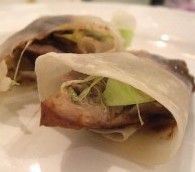
It's a feast fit for emperors. But as Diana Kuan explains, there's more to devouring the iconic dish than you might think.
China’s Theme Parks Look West
by Julia Ross | 11.28.07 | 12:49 PM ET
Call it Interlaken East. Just outside China’s coastal boomtown, Shenzhen—a city better known for shark’s fin soup than grilled bratwurst—a meticulously duplicated Swiss Alpine amusement park is attracting middle class Chinese looking for a vicarious European vacation. In a story on the rising popularity of Western-themed amusement parks in China, Time magazine reports that the Shenzhen project, called OCT East, spared no effort in recreating a Swiss village (the real Interlaken is pictured): “Last summer, an Alpine songfest brought yodelers. A wooden Christian chapel sits above a Swiss clock made from flowers. You can tour the whole property aboard an antique railroad that circles it, or view it from the highest summit—some 50 feet high—before plunging down the slope on the gondola-cum-roller coaster.”
In Search of the Perfect Dumpling in Shanghai
by Joanna Kakissis | 11.26.07 | 11:09 AM ET
In Shanghai, the dumpling known as xiao long bao is on the city’s list of “protected traditional treasures.” It was invented in Shanghai, which made an excellent setting for a witty and mouth-watering piece in the International Herald Tribune by intrepid travel writer and World Hum contributor Daisann McLane. During the course of three days, she taste-tested her way through the city, looking for the perfect dumpling.