
Destination: India
‘Beatles’ Ashram’ in India to Become Eco-Hotel, School
by Michael Yessis | 12.19.07 | 10:32 AM ET
Travelers have been making pilgrimages to Rishikesh, India to visit Maharishi Mahesh Yogi’s ashram, aka the “Beatles’ ashram,” ever since the Fab Four landed there in the late ‘60s to study Transcendental Meditation and write some songs, including “Revolution” and “While My Guitar Gently Weeps.” Soon, though, the rundown 15-acre campus may become a home and school for street children, as well as a 10-room “eco hotel” where visitors “could volunteer to work with the children or simply relax in the same ashram where John Lennon searched for the meaning of life and George Harrison worked to perfect his sitar playing,” according to the Washington Post.
 Email to friend
 del.icio.us
 Digg
Digg Facebook
 Furl
Furl Ma.gnolia
 Mixx
Mixx Reddit
 StumbleUpon
 Yahoo! Buzz
Mumbai Plans Museum for Rudyard Kipling
by Jim Benning | 12.07.07 | 12:30 PM ET
The Mumbai house where Rudyard Kipling was born and lived until the age of 6 will become a museum honoring the writer—a sure sign, some say, that India is beginning to embrace him, despite his imperialist stance. An English professor at the Indian Institute of Technology in New Delhi told the Telegraph: “It’s part of the process of India finally pardoning Kipling.”
Photo: AP.
New Travel Book: ‘Ganga’
by Frank Bures | 12.07.07 | 11:04 AM ET
Full title: “Ganga: A Journey Down the Ganges River”
Author: Julian Crandall Hollick, who also guided a six-part NPR series on the river.
Released: Oct. 15, 2007
Travel genre: River travel
Territory covered: India
Mumbai and the Proximity of Elegance and Squalor
by Joanna Kakissis | 12.06.07 | 9:47 AM ET
The middle of the night is “not such a bad time to arrive” in Mumbai, Thomas Swick writes in a engrossing story in the South Florida Sun-Sentinel. The darkness hides the city’s sins, such as the searing poverty. By daylight, however, you see the slums but also the garlanded temples, Bollywood wealth, the elevator operators reading Oliver Sacks, the carnivalesque tourist district of Colaba, the “harsh, utilitarian cacophany” of Crawford Market.
Go Forth And Run: Marathon Tours Taking Off
by Eva Holland | 11.14.07 | 11:25 AM ET
We recently blogged about urban running tours that allow devoted runners to take in some sights while getting their daily exercise fix. Now, an increasing number of travel agencies are promoting marathon packages—to destinations all over the world, writes Andy Riga in The Montreal Gazette. Want to run the Taj Mahal Marathon? Or the Rock ‘n’ Roll Arizona Marathon? Somewhere, according to Riga, there is a package tour that will get you there—though don’t expect they’ll guarantee a personal best time.
Luxury Jets Are a Girl’s Best Friend?
by Eva Holland | 11.08.07 | 11:15 AM ET
Media in India have been buzzing over news that the nation’s richest man, Mukesh Ambani, has given his wife an Airbus A319 jet (like the one pictured) for her 44th birthday. The $60 million birthday gift is tricked out with satellite TV, gaming consoles, wireless Internet, and a sky bar, according to Reuters. Wrote one commentator: “In a country that prizes asceticism—think of Mahatma Gandhi, who visited Buckingham Palace in a loincloth and little else—Ambani is setting spectacular new standards for conspicuous consumption. In Mumbai he’s constructing a 27-storey, US$150 million high-rise apartment block that will house his family of six.”
How to Wear a Sari in India
by Anita Rao Kashi | 11.08.07 | 10:43 AM ET
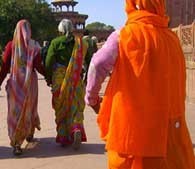
It's not as complicated as it might appear. Anita Rao Kashi reveals what it takes to get the elegant traditional Indian dress just right -- and to get the right one for you.
Indians in Bali: The ‘New Americans’?
by Liz Sinclair | 10.30.07 | 7:04 AM ET
In the wake of the Bali bombings, the country’s traditional tourists—Americans, Australians and Europeans—started to vacation elsewhere. Asians from countries such as India, experiencing rapid economic growth, filled the gap. But as Karim Raslan notes in a recent article for the Financial Times, there’s something familiar about these tourists. They often behave with the same cultural elitism that characterized the stereotypical American, becoming, as Raslan calls them, the “New Americans.”
A Daring Cup of Tea in Darjeeling
by Joanna Kakissis | 10.19.07 | 10:47 AM ET
How far would you go for a cup of tea? Matt Gross, the Frugal Traveler for The New York Times, went deep into West Bengal and the Himalayas to explore the tea estates of Darjeeling country and sample varieties of the coveted teas. The hours-long journey to Darjeeling is like “a teetotaler’s version of a Napa Valley tour but without the crowds,” Gross writes. Getting to this remote corner of India is also apparently spine-chilling: the steep drive up and down decrepit roads has caused more than a few fatal plunges and Gross anxiously notes rough trips between estates.
Travel in 2017: Start Learning Chinese and Changing Your Eating Habits
by Michael Yessis | 10.18.07 | 2:59 PM ET
The Freakonomics guys aren’t the only ones this week with an eye on the future of travel. Forbes delivered a special report about “The Future,” which features some provocative speculation on travel in the year 2017 from World Hum contributor Elisabeth Eaves. Among her predictions:
Thomas Swick Takes On Agra Station
by Eva Holland | 10.18.07 | 7:59 AM ET
In his latest column in the South Florida Sun-Sentinel, Thomas Swick describes his arrival at the station in Agra, the former capital of the Mughal Empire and home of the Taj Mahal. Foreign train stations, Swick writes, “have always held a certain terror for me.” But Agra’s was even more intimidating than most: “I stepped over sleeping bodies on the sidewalk and rolled my suitcase into a human maze. Crowds engulfed the platform, grudgingly making way for porters, machinery, luggage, new arrivals. There was no visible information, though every once in a while a woman’s voice—soothing in this predominantly male world—descended from the PA system. I couldn’t understand a word.”
‘The Darjeeling Limited’: A New Wanderers’ Classic?
by Elisabeth Eaves | 10.09.07 | 11:53 AM ET
Hollywood rarely produces a great travel film. It endlessly mines the road trip for material but doesn’t get at the actual experience of travel, the drama of which, for most of us, involves neither bad guys nor tragic endings, but rather logistical snafus and the occasional small epiphany. So it was with trepidation that I approached director Wes Anderson’s new movie The Darjeeling Limited, about three bumbling brothers on a train trip through India. By the end, though, I wanted to join the protagonists as they ran, yet again, for the train. “The Darjeeling Limited” is a fresh and funny lesson in that most ancient piece of travel wisdom—it’s about the journey, stupid, not the destination.
Board the Airbus 300—to Nowhere
by Michael Yessis | 10.02.07 | 8:01 AM ET
The plane never leaves the ground, and might only spin in circles if it tried—it only has one wing and a hint of a tail. Yet the $4 tickets are going fast. According to the Times of London, 99 percent of India’s population has never traveled on a plane, so retired Indian Airlines engineer Bahadur Chand Gupta has set up “virtual journeys” on an old Airbus 300 in Delhi.
The Critics: Paul Theroux’s ‘The Elephanta Suite’
by Frank Bures | 09.27.07 | 11:00 AM ET
Paul Theroux is back, right on schedule, with a new book of fiction, this time a collection of three novellas about Westerners in India called The Elephanta Suite. Pico Iyer gives it a glowing review in Time, calling it “a set of brilliantly evocative and propulsive novellas.”
‘Human Horses’ Defy Calcutta Rickshaw Ban
by Eva Holland | 09.13.07 | 12:00 PM ET
For more than a century, hand-pulled rickshaws have rolled through the busy streets and narrow alleys of Calcutta—or Kolkata (yes, we got the memo). But last month the BBC reported that the state government of West Bengal would be banning Calcutta’s famous human-powered transport. Now, the AFP has released this video report showing both rickshaw pullers and regular customers voicing their opposition to the ban. One customer noted that they were the only affordable transport for the injured or the sick, and wondered about compensation or re-training for the pullers. One rickshaw-puller said simply, “I have never done anything else.”