
Travel Blog
What We Loved This Week: Disco Papa, Oregon Trail and ‘Ghost Wars’
by World Hum | 02.06.09 | 4:08 PM ET
Our contributors share a favorite travel-related experience from the past seven days.
Michael Yessis
A touching and hilarious story by Karen Russell, who took her 85-year-old grandfather—Disco Papa—to a cruise ship nightclub.
Rob Verger
I loved the snow in New York City on Tuesday. I watched it falling steadily from inside all day, and then late in the afternoon I stepped outside into next-door Sakura Park and snapped this picture:
Joanna Kakissis
I’m reading “Ghost Wars: The Secret History of the CIA, Afghanistan, and Bin Laden, from the Soviet Invasion to September 10, 2001” by Steve Coll. In addition to exploring foreign policy blunders (and the U.S. made many of them), the Pulitzer-Prize-winning book also offers rich portraits of Afghanistan and Pakistan, two countries I’ve always wanted to experience.
Eva Holland
Last weekend I had the chance to watch the Chinese New Year parade in Manhattan’s Chinatown. I was a little surprised to see the number of insurance companies (and fast food chains) represented, but still loved
being there in the crowd, listening to the sounds of the parade going by and occasionally having glitter and silly string rain down on me.
Valerie Conners
Discovering the original, old-school version of Oregon Trail online. This has been the ultimate find, and is serving well as a procrastination tool for my Friday afternoon. It’s a trek back to 1985, my Apple IIC computer, the days of uber-pixelated screens and what was, perhaps, my very first yen for road tripping.
Jim Benning
Another great World Hum gathering in New York City. Lolita Bar’s basement was packed last night with readers, writers and travelers tossing back drinks and talking trips. It culminated in a late dinner, replete with duck tongue and rice porridge, at Congee Village. Thanks to all who came out.
 Email to friend
 del.icio.us
 Digg
Digg Facebook
 Furl
Furl Ma.gnolia
 Mixx
Mixx Reddit
 StumbleUpon
 Yahoo! Buzz
Should Eco-Tourists Really Eat the Chilean Sea Bass?
by Joanna Kakissis | 02.06.09 | 11:25 AM ET
I love to eat fish. Stewed, grilled, broiled and curried, as ceviche or in sushi—wherever I travel, I seek out the restaurants that know how to pick it fresh and prepare it well. Or used to, anyway. After recently hearing about a book, “An Unnatural History of the Sea,” and realizing that humans have essentially overfished many species to the brink of collapse, I’ve decided to use the Blue Ocean Institute’s FishPhone when I want to order seafood at a restaurant or buy it at a grocery store. For instance: I want to order snapper, a favorite, but I have no idea if it’s one of the species that’s at risk. I text the FishPhone (FISH SNAPPER) send to 30644 and within seconds, this ominous note returns: “Snapper (RED) significant environmental concerns; fisheries management is poor and populations are declining.” Eek.
Where Kawelo Makes Fire
by Pam Mandel | 02.06.09 | 10:15 AM ET
 Photo by Nerd's Eye View
 You need a four-wheel drive vehicle to get to Keahiakawelo, the Garden of the Gods, on Lana’i. The dusty rough track ends at Polihua Beach, an isolated stretch of white sand and unswimmable surf (the tides are dangerous; don’t even think about it).
If you take the boat from Maui, you’ll share the deck with locals carrying enormous ice chests, household appliances (we watched a guy load a washing machine) and piles of groceries. There are also a handful of rugged backpackers, motorcycle riders and well-heeled tourists in khakis and sunhats carrying golf clubs.
The carved stone marker towards the top of the road says “Garden of the Gods” but Keahiakawelo actually means “the place where Kawelo makes fire” or “the fire of Kawelo.” According to the Hawaiian legend, the landscape was transformed into bare, red rock slopes by Kawelo’s burning every single stick of vegetation in a competition against another kahuna to see who could keep the fire going the longest.
I learned this from Kepa Maly of the Lana’i Culture and Heritage Center—the center must be one of the most under-visited facilities in the islands. I also learned that there are artifacts that show human habitation of Lana’i from 1,000 years ago and had my brain short out on the idea that an entire island (it’s actually 98%) could be owned by a pineapple company and then a hotel company. The island still has a weird colonial vibe, and before I was taken down by seasickness in the Maui channel, I was glad to be moving on.
Morning Links: Disney’s Small World, Travel Writers Worth Following and More
by Michael Yessis | 02.06.09 | 8:38 AM ET
- USA Today’s cover story focuses on the upside for hotel guests in a down economy.
- Video: Scenes from inside airport X-ray machines. (via Coudal)
- Inside the tunnels of Gaza.
- Brave New Traveler interviews Pauline Frommer.
- One person who isn’t getting that island dream job: Osama Bin Laden
- What humans can learn about traffic control from ants.
- The Wall Street Journal’s Book Lover included Redmond O’Hanlon and Tim Butcher among her “travel writers worth following.”
- Slideshow: Evan Osnos looks at “the economic, social, and religious life of African migrants in Guangzhou.”
- Disneyland’s Small World overhaul debuts today. The AP has video. Is the song stuck in your head yet?
Got a suggestion? .(JavaScript must be enabled to view this email address) your link.
Postcards From the Real World
by Sophia Dembling | 02.05.09 | 4:20 PM ET

I like buying postcards when I travel, partly because I’m cheap, but also because they’re fun to collect and to mail to friends anytime.
But my favorite postcards, the ones I cherish and don’t send to anyone, don’t have postcard-perfect images. Watch my slideshow and see what I mean.
Cutting the Cord on Expensive Hotel Internet Service
by Alexander Basek | 02.05.09 | 4:01 PM ET
Thank you, Shangri-La Hotels, for breaking the cycle of expensive internet access. The hotel chain announced that it’s offering free Wi-Fi throughout its 60 properties as of, oh, right now. It’s about damn time—not at Shangri-La specifically, but for hotels in general to start offering this “service” for free, as it should be.
What’s galling is how the higher-end properties love to tack on this charge, while smaller one-off properties tend to give it away for free. It’s shortsighted and unrepresentative of how people travel: wouldn’t you prefer to have free internet access as opposed to free access to, say, Headline News? Not that we don’t all love Nancy Grace. Besides, I’m probably preaching to the internet choir here.
Still, it’s hard to forgo the internet when you work while you travel. I paid exorbitant internet fees many a time in 2008, and I’m sure it’ll happen again in ‘09. At the top of my list: a $15-a-day fee at the Grand Hotel Pupp in Karlovy Vary, Czech Republic. It’s a beautiful, historic hotel—James Bond even stayed there in Casino Royale—but it’s tough to feel as suave as Daniel Craig when you have to trudge downstairs for an ethernet cable first.
Buyer Beware: Worst. Deals. Ever.
by Eva Holland | 02.05.09 | 1:54 PM ET
Here’s an unexpected bit of fun (not to mention a refreshing dose of honesty) from travel discount aggregator, DealBase.com: a collection of the very worst non-deals in their system. Check out this Special Rate for Government Associates at a Denver hotel, for instance; as DealBase’s trademark “Deal Analyzer” points out, this “special rate” actually tacks on an additional $94 per night, or an unlovely savings rate of -171 percent. (Given that the “deal” is for government only, maybe we can call it a political protest of some sort?) DealBase is a relative newcomer to the online bargain-hunting scene, and it’s nice to see that it brought its sense of humor to the party.
Would You Like the Chicken, the Fish or the Dead Hamster?
by David Farley | 02.05.09 | 12:20 PM ET
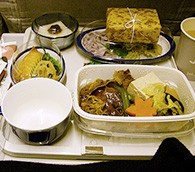
Oh, airline food. Always getting the bad rap. We love to hate airline food. The hate brings us together. It’s airplane conversation starter. I might be one of the few people who doesn’t dislike airline food. Consider the context: you’re eating 30,000 feet above the earth. If I were sitting in a Michelin-starred restaurant, eating soggy croquettes out of a tin tray, I’d probably be a bit disappointed. But on a plane I’m captive. Which is why I watch (and actually enjoy) Drew Barrymore movies while I’m flying. I fork the rubbery chicken into my mouth and like it.
Then there’s this guy. The Virgin Atlantic frequent flyer who had had enough. Food, that is. He wrote a scathing—and humorous—letter to Sir Richard Branson, Virgin’s founder and CEO, about his latest meal on the London-to-Mumbai flight. An excerpt after the jump.
Falcons, Gulls and Clams at Kennedy Airport
by Rob Verger | 02.05.09 | 11:21 AM ET

There’s been a lot of press lately about airplanes and bird strikes, but the story I’ve found most interesting comes from John F. Kennedy International Airport—it’s the only U.S. commercial airport that uses falcons as a means of controlling the local bird population. It’s an effective way to deal with the bird issue, for the simple reason that while birds can get used to noise, they never habituate to having a natural predator in the area.
The project is run by Falcon Environmental Services, and in addition to JFK, the company has contracts at two U.S. Air Force bases, and a few airports in Canada. At JFK, from May 1 to the end of October, sunrise to sunset, two teams patrol the airfield in covered pickups with falcons on perches in the back.
To learn more about the project, I called up John Kellerman, the manager of operations at JFK for Falcon Environmental. He’s a retired New York City Police Sergeant, and has been working as a falconer at JFK for four years. He spoke to me over the phone from his home on Long Island.
I asked him what kinds of birds they usually encounter. “It depends upon the time of year,” he said. “When we get there in May, we have large flocks of cormorant going by, we have large flocks of geese going by, brant in the early season. Then during the course of the summer we have gulls—herring gulls, laughing gulls, black-backed gulls—they’re offshore feeding.”
Rome: All the ‘Angels and Demons’ You Can Handle
by Eva Holland | 02.05.09 | 10:04 AM ET

As we’ve noted before, expectations (and concerns) are high for Dan Brown-related tourism in Rome as the release of the big-screen adaptation of “Angels and Demons” draws nearer.
The movie isn’t due out until May, but that hasn’t stopped Roman tour operators from getting an early start. In fact, as Jessica Spiegel points out in a post at WhyGoItaly, “Angels and Demons” themed tours have been popular with visitors to Rome ever since the Dan Brown phenomenon really took off a few years back. She’s got the details on six different tours on offer in the Eternal City (Six! And people say nobody reads anymore), along with a stern warning to anyone who might be planning to bring a chisel along for the ride. For those so inclined, the movie trailer is after the jump.
Morning Links: Americans Behaving Badly, Disappointing Attractions and More
by Michael Yessis | 02.05.09 | 8:47 AM ET
- Tamaulipas declared itself bilingual, the first Mexican state to do so.
- Ben Groundwater lists his picks for the world’s most disappointing tourist attractions.
- Aeroflot apologizes for pilot’s “slurred preflight announcement,” but denies he was drunk.
- McSweeney’s reveals what happens when “the 4-year-old crash-lands in the Andes.”
- The sites of London can be compressed into “just four handy photographs,” writes Matthew Summers-Sparks.
- Trains, slum rooftops and Google Earth all factor into this art project in Kibera, Kenya. (Via Daily Dish)
- A man was caught at customs in Melbourne with birds beneath his trousers.
- Here’s where Americans are getting arrested abroad. Not surprised at all by the top spot: Tijuana.
Got a suggestion? .(JavaScript must be enabled to view this email address) your link.
Destination: Anywhere (in Las Vegas)
by Alexander Basek | 02.04.09 | 3:49 PM ET
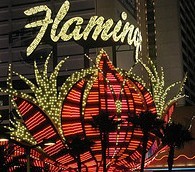
The New York Post’s recently released Destination Guide to Las Vegas is out, and it’s worth a read. Think of it as the first Vegas guide that addresses our new reality, both for visitors (who are now more budget-minded than ever) and for properties (who really, really want you to come to the desert, no matter what it takes).
Hotels in Las Vegas are in an interesting spot these days. Hotel companies there can make money outside of their rooms—it was their business model for many years—so properties are slashing prices left and right to get warm bodies in the beds. To anyone that can make it over there, especially during midweek, it means way more money to spend at Bill’s $3 roulette table. Yay! As for specific sleeps, the Post gives a now de rigeur nod to the Flamingo’s GO Rooms—they first discovered them, after all—as well as busting the Venetian as the hardest place to navigate on the Strip. No kidding. During my last visit I had to have a little old lady selling hotel-branded credit cards ferry me to the exit. Next time, I’m bringing a GPS.
Touring Tokyo’s Underbelly
by Julia Ross | 02.04.09 | 2:17 PM ET
I’ve been a fan of MP3 audio tours since I discovered the transporting Soundwalk series several years ago. In fact, Soundwalk’s moody MP3 tour of New York’s Chinatown still reverberates in my ears every time I walk down Mott or Bayard Street in lower Manhattan. So I wish Tokyo Realtime’s new audio tour of Kabukicho, Tokyo’s red light district, had been available when I visited the city in 2007. From the preview posted on their site, the tour mixes just the right amount of music, political commentary and local history to make at least one corner of the overwhelming metropolis accessible. And god knows, anything that helps tourists cut Tokyo down to bite-size portions is helpful.
Those looking for the peep shows and brothels documented in the tour may be disappointed, however. The Guardian reports efforts are under way to clean up Kabukicho in line with the city’s short-listed bid to host the 2016 Olympics.
Island Eats: Spam Musubi
by Pam Mandel | 02.04.09 | 11:39 AM ET
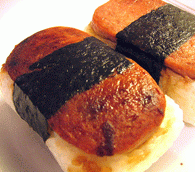
Blame WW II. It was the food of soldiers stationed in the islands and somehow, it stuck—cans of the meat-like product making their way past the gates of military bases and into Hawaiian daily life. According to an older article in the Honolulu Star-Bulletin, islanders go through 7 million cans of Spam annually. Spam seems to show up everywhere Hawaiians are found—Hawaiian center fielder for the Phillies Shane Victorino took heat last year from PETA (People for Ethical Treatment of Animals) for admitting that Spam musubi was one of his favorite foods. And stalkerish reporting on every action taken by our new president on his last trip to the islands revealed that he ordered Spam musubi for lunch while on a golf outing.
Fly the ‘Green’ Skies With Camelina (and Pond Scum)
by Joanna Kakissis | 02.04.09 | 10:41 AM ET

OK, OK ... it will be many, many years before camelina and algae replace petroleum in jet fuel, but I’m glad the aviation industry is at least exploring environmentally responsible options. Last week, Japan Airlines became the latest carrier to test biofuels on one of its jets, circling a Boeing 747 powered by mix of camelina, jatropha and algae oil over the Pacific Ocean.
By all accounts, the one-hour flight went smoothly, as did previous biofuel test flights by Virgin Atlantic (powered in part by coconut and babassu oil), Air New Zealand (jatropha oil) and Continental (jatropha and algae oil). Greenvolutionaries have been hating for years on traditional (read: fossil-fuel-based) jet fuel, a major contributor of greenhouse gases. So energy companies such as Arizona’s PetroSun and Montana’s Sustainable Oils are loving the good vibes and (so far) good results in developing clean, next-gen jet fuels.
The Finns have predicted that all planes will be running on biofuel by 2093. I know, that’s like 84 years away, but since oil reserves are only expected to last a few more decades, I really hope they’re right.
