
Destination: Asia
Interview With James Wallace: Reflections From an Aerospace Reporter
by Rob Verger | 04.03.09 | 9:26 AM ET
 Photo courtesy of James Wallace.
 Award-winning reporter James Wallace covered aerospace for the Seattle Post-Intelligencer for more than 12 years. He worked for a total of 27 years at the paper, which recently stopped printing and transitioned to an online-only version with a comparatively tiny reporting staff. When that happened, Wallace’s job disappeared.
Wallace, who wrote a goodbye blog entry, is the author of two books, “Hard Drive” and “Overdrive,” both about Microsoft.
I caught up with him over the phone to hear about his years on the aviation beat.
World Hum: You covered aerospace for 12 years. How have you seen commercial air travel change during that time?
 Email to friend
 del.icio.us
 Digg
Digg Facebook
 Furl
Furl Ma.gnolia
 Mixx
Mixx Reddit
 StumbleUpon
 Yahoo! Buzz
Manga Madness
by Julia Ross | 04.02.09 | 1:14 PM ET
For all you manga fans out there, here’s a round-up of breaking news from both coasts. A San Francisco-based publisher recently released seven translated volumes of the classic Oishinbo series, which follows the adventures of a young food journalist as he searches for the “ultimate menu.” (Tintin meets sashimi?) The New York-based Japan Society is running an exhibit called “Krazy! The Delirious World of Anime + Manga + Video Games” through June 14. And in Washington, D.C., the Arthur M. Sackler Gallery is showing “The Tale of Shuten Doji,” an exhibit of scrolls and screens depicting the popular Japanese folk tale as action thriller—an Edo period art form considered a forerunner to manga.
Chinese Tourists Deluge Taiwan
by Julia Ross | 04.02.09 | 10:13 AM ET
It got off to a slow start, but a long-awaited travel agreement between China and Taiwan, forged last summer, has finally yielded a huge bump in mainland tourists traveling to the island.
Clockwatching in Western China
by Julia Ross | 04.01.09 | 12:44 PM ET

If you’re traveling in Kashgar, China, over the summer, don’t be surprised if the sun sets at 11 p.m. That’s because the old Silk Road city—like all of China—is required to follow the clock in Beijing, some 2,000 miles east. Aside from throwing circadian rhythms out of whack, the policy has exposed political fault lines in the region: the minority Muslim Uighurs, resentful of Chinese suppression of their culture, insist on setting their own clocks, two hours earlier.
Video: How to Drink Tea in China
by Matteus Frankovich | 04.01.09 | 8:34 AM ET
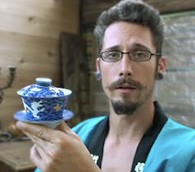
Grab your gaiwan and tea leaves. Matteus Frankovich explains the proper way to drink tea in China.
Seoul, South Korea
by World Hum | 03.31.09 | 11:08 AM ET
 REUTERS/Jo Yong-Hak
 A man stands in front of a statue titled "Seoul broods a golden egg" at the Seoul city hall plaza in central Seoul.
Paperbacks at 15,000 Feet
by Eva Holland | 03.30.09 | 1:20 PM ET
Book Bench blogger Willing Davidson did a little book-spotting on a recent Nepalese trek; in this brief, fun post, he reports back on the most popular titles in his “mile-high book club.”
In Hong Kong, Taking the Rugby Cure
by Julia Ross | 03.30.09 | 10:21 AM ET
Recessionary times didn’t keep the Hong Kong Sevens rugby tournament from continuing its storied tradition of “off-the-hook drinking and off-the-record debauchery” this weekend, reports the New York Times. Expat lawyers, diplomats and bankers from across Asia turned up in Hong Kong Stadium dressed—in keeping with tradition—as gladiators, ballerinas, cowboys and lifeguards. “Nothing can touch the Sevens,” declared one banker, fending off queries about corporate cutbacks. Good to know someone’s partying, even if it’s on the other side of the world.
A Global Rite of Spring
by Julia Ross | 03.27.09 | 12:31 PM ET
Ah, springtime in the nation’s capital. I saw my first cherry blossom of the season near the Washington National Cathedral a couple weeks ago, and it immediately lifted my will-winter-never-end mood. The blossoms are right on schedule here—peak period is expected to be April 1-4—but over in Tokyo, the much admired sakura are early for the fourth year in a row, prompting hand-wringing about the effects of global warming. According to the Telegraph, Japan’s national “blossoming line”—the latitude at which the trees start to flower—has shifted 125 miles north over the last 40 years. Kind of alarming.
If you missed the window in Tokyo, I’d recommend a visit to Washington’s National Arboretum instead of the Tidal Basin (way too crowded) or a virtual viewing via this web cam. Of course, there are plenty of pink wonderlands unfolding beyond the Beltway. Check out the cherry blossom festivals in San Francisco, Philadelphia or Brooklyn. And don’t forget the sake.
Swayambhunath Temple, Kathmandu, Nepal
by World Hum | 03.27.09 | 11:11 AM ET
 REUTERS/Chaiwat Subprasom
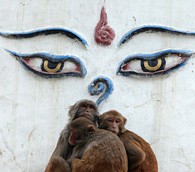
 Monkeys sit on a stupa at the Swayambhunath temple in Kathmandu.
Risky Business: Playing the Numbers Game
by Eric Weiner | 03.27.09 | 9:49 AM ET
 REUTERS/Thaier al-Sudani
 On the intersection of place, politics and culture
Returning Home: A Tougher Transition?
by Julia Ross | 03.26.09 | 11:08 AM ET

In a recent Wall Street Journal column, Alan Paul writes that he’s feeling persistent grief, three months after returning to the U.S. following a three-year stint in China. He misses his neighborhood noodle restaurant in Beijing, and his kids miss the friends they made at their international school. It’s been a rougher transition than moving to Beijing in the first place, a sentiment shared by several former expats he interviews about cultural re-entry.
“I have certainly found myself carrying a heavier sense of loss here than I ever did there,” he notes. “During my stay in Beijing, people in the U.S. would ask me about missing home and often didn’t believe me when I said it wasn’t a problem. I longed for specific people or places, sometimes profoundly, but I never had a deep sense of loss, simply because I knew that my old existence wasn’t gone forever; it was on hold and I would be returning to it ...”
Today Art Museum, Beijing, China
by World Hum | 03.26.09 | 9:28 AM ET
 REUTERS/David Gray
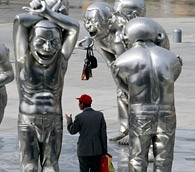
 A man walks through a group of works by Chinese artist Yue Minjun, one of which is carrying women's handbags, on display outside the Today Art Museum in central Beijing.
Tibetan Monks, In Nine-Part Harmony
by Julia Ross | 03.25.09 | 1:00 PM ET
Here’s a new way to express support for Tibet, if you’re so inclined: Pick up a copy of this CD, produced by the Grateful Dead’s Mickey Hart, of the Gyuto Monks Tantric Choir, chanting in multiple overtones at once (similar to the Tuvan throat singers). National Public Radio has a fascinating story about how the CD was produced, based on a rare 1960s recording of Tibetan monks in northern India made by religion scholar Huston Smith. NPR has a sample of Smith’s original recording online. Apparently the trained ear can discern up to nine harmonies sung by a single monk at one time; to me, the only word for it is “otherworldly.”
Proceeds from the CD support the New York-based Tibet House and the Tibetan Gyuto monastery-in-exile.
Quyang, China
by World Hum | 03.25.09 | 10:40 AM ET
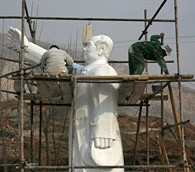 REUTERS/David Gray
 Sculptors work as they stand on scaffolding surrounding a statue of the late Chinese chairman Mao Zedong in the town of Quyang.