
Destination: South America
Malcolm Gladwell on Aviation Safety and Security
by Rob Verger | 01.30.09 | 2:00 PM ET

Perhaps the most fascinating section of Malcolm Gladwell’s new book, Outliers: The Story of Success, is the chapter called “The Ethnic Theory of Plane Crashes.” Gladwell explores two plane crashes—one Colombian (Avianca Flight 52) and another, South Korean (Korean Air Flight 801)—and how the culture of the pilots perhaps contributed to each disaster. He focuses on how well the pilots communicated with each other and with air traffic control. Poor communication in these examples, he argues, has to do with something called a culture’s Power Distance Index (P.D.I.)—the term and concept come from psychologist Geert Hofstede—which is a measurement of “how much a particular culture values and respects authority,” as Gladwell defines it. Countries with a high P.D.I. generally value being more deferential towards authority, and thus not contradicting a superior (the U.S. and New Zealand both have a low P.D.I.). Gladwell argues that since both Colombia and South Korea rank towards the top of the P.D.I. list, the subordinate members of their cockpit crews were unable or unwilling to speak up as assertively as they should have about safety concerns.
I interviewed Gladwell in early November for an article for The Boston Globe and asked him if he would suggest changing anything in general regarding airline security. “Not really,” he answered, but added that he was more concerned “about the mistakes that pilots make and air traffic controllers make in the course of doing their jobs than I am about the threat posed by terrorists. It’s the classic thing where we demonize and terrify ourselves about the threat from outside and forget about the threat that we pose to ourselves.”
But it’s the connections that Gladwell draws in “Outliers” between culture and plane crashes that have become, not surprisingly, controversial.
 Email to friend
 del.icio.us
 Digg
Digg Facebook
 Furl
Furl Ma.gnolia
 Mixx
Mixx Reddit
 StumbleUpon
 Yahoo! Buzz
Morning Links: Sex and Romance in Rio, Chaos in Bangkok and More
by Michael Yessis | 01.28.09 | 8:50 AM ET

- Love this graphic of anatomical terms that most sound like exotic vacation destinations. I’m booked for the Fissure of Rolando.
- Cole Hamels loves Sydney.
- Giant waves battered cruise ships in the Bay of Biscay. Photos at the Daily Mail.
- GOOD rightfully thinks trains need some more support—and more money—on Capitol Hill.
- Inside the quest for alternative jet fuels. Black vomit nut, anyone?
- Another great Time Zones piece: “The Beautiful Chaos of Bangkok”
- Sex and Romance in Rio: Seth Kugel looks at the relationships between male tourists and female locals. Some background on the story.
- A Fugu mishap in Japan injures seven.
- Have you read “the world’s best passenger complaint letter”?
- An Alaskan entrepreneur wants a license to sell booze on his Fairbanks shuttle bus. His goal: To make enough money so he can hire another shuttle bus driver and join the mobile party. (via Fark)
Got a suggestion? .(JavaScript must be enabled to view this email address) your link.
Video: How to Use a Machete
by World Hum | 01.22.09 | 9:18 AM ET

Far flung travel sometimes requires a little bushwhacking. Rowan Doff explains.
Video: How to Sleep in a Hammock
by World Hum | 01.06.09 | 9:01 AM ET
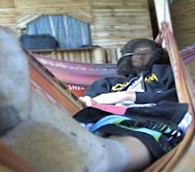
Daniel Beck explains the ins and outs of taking a snooze in a swinging bed
Morning Links: India Security, Peruvian Shamans, Las Vegas and More
by Jim Benning | 12.30.08 | 11:08 AM ET
- Is India safe for travelers? Depends who you ask.
- The Japanese man who mysteriously moved into Mexico City’s airport four months ago and became a celebrity of sorts up and left on Sunday. Go figure.
- Peruvian shamans held a ceremony to “protect the spirits” of Barack Obama and other leaders in 2009.
- Family members of the woman who disappeared off a cruise ship near Cancun say they believe she jumped, citing “previous emotional issues.”
- The Washington Post reviews “Bad Traffic, “a new novel from Welsh writer Simon Lewis, who “first gained attention as a travel writer.”
- Which helps impoverished people in developing countries more, cell phones or laptops? Good magazine debates the question. (Via Ideas Blog)
- In October, the last month for which numbers are available, gambling revenue in Las Vegas was down “an ominous 24.3% vs. the same month in 2007.” And that’s just the beginning. But hey, it’s nearly New Year’s Eve, so get out there and help the struggling city: Double down on 17.
Colombia On Film (Again)
by Eva Holland | 12.29.08 | 1:17 PM ET

Sure, 2007’s Love in the Time of Cholera may never have become the big Colombian movie-tourism ticket that we were expecting (the film adaptation of the Gabriel Garcia Marquez classic tanked, critically and at the box office), but Cartagena—the city where “Cholera” was set—isn’t done yet.
There’s a new Cartagena-set movie in the works (called, appropriately enough, Cartagena) that will star Clive Owen as “an undercover agent at the center of the world’s cocaine trade,” as Get The Big Picture blogger Colin Boyd puts it.
Morning Links: Goa Beach Parties, Kim Jong Il’s Childhood Home and More
by Michael Yessis | 12.23.08 | 9:37 AM ET
- Arab women are finding new freedoms as flight attendants.
- In the U.S., a former T.W.A. flight attendant looks back on the days “when there were three dinner options on flights from Boston to Los Angeles—in coach.”
- Kim Jong Il’s childhood home in South Korea is open to travelers.
- The economic crisis hits the glass blowers of Murano.
- There will be no Goa beach parties in the coming weeks. Indian authorities are worried about security after the Mumbai terrorist attacks.
- Recce posted its Best Stories of 2008.
- Christopher Elliott offers some travel strategies for 2009.
- William Langewiesche reconstructs the collision of two planes over Brazil in 2006. Joe Sharkey has a few harsh words for the story.
- Airport security in Birmingham, England strip searched a clown. PC Konk the Clown said, “I’ve never had this problem before when I’ve been to international clown conventions abroad.” My favorite part is the groan-inducing headline: “Clown Finds Airport Security no Laughing Matter.”
Argentina: Home to ‘The World’s Most Annoying Economic Crisis’
by Michael Yessis | 12.03.08 | 4:15 PM ET
There’s a coin shortage in Argentina, and it’s driving people in the country bonkers. It’s particularly acute in Buenos Aires. Joe Keohane explains in a story for Slate:
Everywhere you look, there are signs reading, “NO HAY MONEDAS.” As a result, vendors here are more likely to decline to sell you something than to cough up any of their increasingly precious coins in change. I’ve tried to buy a 2-peso candy bar with a 5-peso note only to be refused, suggesting that the 2-peso sale is worth less to the vendor than the 1-peso coin he would be forced to give me in change.
A benefit for some travelers: “Subway employees are occasionally forced to wave commuters through because they are out of coins,” Keohane writes.
The Quichua Cacao Farmers Behind Kallari Chocolate
by Joanna Kakissis | 11.12.08 | 9:33 AM ET
The $5.95 bars of rich, smooth Kallari artisan chocolate sold at Whole Foods come from an island on the Napo River in Ecuador’s rain forest. The Quichua people have been farming cacao for generations and then selling it, but now they’ve cut out the middleman and are making and marketing the chocolate themselves. The New York Times reports that they may be the only cacao farmers in the world who make and market their own chocolate.
How Can I Save on Transportation During a Round-the-World Trip?
by Rolf Potts | 11.06.08 | 12:34 PM ET

Vagabonding traveler Rolf Potts answers your questions about travel
The ‘Peruvian Pan Flute Epidemic’ Rages on ‘South Park’
by Michael Yessis | 10.27.08 | 7:32 AM ET
Peruvian flute bands are apparently a big enough phenomenon—and irritating enough to Trey Parker and Matt Stone—to take center stage on “South Park.” The latest episode warns of a “Peruvian flute band epidemic” so extensive that the head of Homeland Security says, “All over the world wherever there are tourists or shoppers there are now on average 65 Peruvian flute bands per square kilometer.”
Move Over Bookmobile: Make Way for the Biblioburro
by Valerie Conners | 10.22.08 | 10:04 AM ET
The New York Times profiled Luis Soriano, Colombia’s one-man Biblioburro, who—along with his two donkeys, Alfa and Beto—brings books to some of his nation’s most remote and impoverished villages. “This began as a necessity; then it became an obligation; and after that a custom,” Soriano said. “Now it is an institution.”
Threatened Galapagos Considers Limiting Visitors
by Jim Benning | 10.10.08 | 12:26 PM ET
We noted last year that UNESCO added the Galapagos to a list of endangered places, citing a sharp rise in tourists, as well as migrants seeking work in tourism. Now, the Los Angeles Times reports that the Ecuadorian government has begun sending migrants back to the mainland, and it’s considering a management plan that could limit the number of visitors to the islands “with strategies such as raising the entrance fee for foreigners to $300 or more from $100.”
World Hum Travel Movie Club: ‘The Art of Travel’
by Eli Ellison, Eva Holland | 10.09.08 | 5:53 PM ET

Re-Branding Colombia: ‘The Only Risk is Wanting to Stay’
by Jim Benning | 10.02.08 | 1:37 PM ET
Photo of Cartagena by ho visto nina volare via Flickr, (Creative Commons).
What? That’s the only risk? What about the drugs? The rebels? The risk of catching Shakira fever? I was watching “Larry King Live” the other night when I was suddenly faced with something far more interesting than the babbling pundits: a commercial promoting tourism to Colombia. It began with footage of feet walking along a beach and a gentle voice intoning, “You are at risk when you go to Colombia…at risk of amazement, of marveling, of falling in love…” Then came images of a snorkeler in turquoise water and smiling tourists. The kicker? “Colombia. The only risk is wanting to stay.”