
Travel Blog: News and Briefs
Woodstock: Disneyland for Hippies?
by Eva Holland | 04.10.09 | 2:23 PM ET

Well, the 40th anniversary of the mother of all music festivals may still be a few months away, but the “reflecting on Woodstock” pieces are already cropping up. This week, Rock’s Backpages digs up a vicious Rolling Stone piece—circa 1999—from David Dalton, eviscerating the festival as the death of the ’60s dream.
Here’s a sample: “Woodstock, if anything, amounts to the Disneyfication of the entire hippie enterprise—a just-so story about generational togetherness, a sort of temporary ’60s theme park that (alas!) has become an annual institution.”
 Email to friend
 del.icio.us
 Digg
Digg Facebook
 Furl
Furl Ma.gnolia
 Mixx
Mixx Reddit
 StumbleUpon
 Yahoo! Buzz
American Regionalisms Redux
by Jenna Schnuer | 04.10.09 | 1:33 PM ET
We know that loads of you take notice of regional speak as you do your state-to-state wandering. So you’ll definitely want to know about this. But even if you don’t normally listen up for regionalisms and English is your first language, you’re still not off the hook when it comes to Frank Bures’ recommendation that travelers tote along a dictionary on trips.
No, thanks to several decades of work by researchers at the University of Wisconsin-Madison, there’s a nearly-complete multivolume dictionary that will help you understand what’s going on when you get invited to a “pitch-in” in Indiana or which “scrimptions” you should save down South.
A Solar-Powered City to Debut in Florida
by Joanna Kakissis | 04.10.09 | 12:22 PM ET

Photo by albertheaps via Flickr (Creative Commons)
Hey, if the United Arab Emirates can build a giant eco-city in the desert, then sunny Florida should do just fine with a solar-powered town near Fort Myers, in the southwestern portion of the state.
Reuters reports that the developers of the planned $2 billion Babcock Ranch—an environmentally friendly city of 19,500 houses and some six million square feet of space including retail and offices—say it will run on what they bill as the world’s largest photovoltaic solar plant.
Let’s just hope the Sunshine State’s sun city isn’t underwater by the end of the century.
Is Whole Body Imaging Coming to an Airport Near You?
by Rob Verger | 04.10.09 | 10:49 AM ET
Will full-body scanners eventually replace the traditional metal detector as a primary screening device at U.S. airports? It seems likely, reports Joe Sharkey for the New York Times. “Robin Kane, the agency’s acting chief technology officer, said that the initial results from pilot tests at some checkpoints at 19 airports in the United States had been so good that the idea of using the machines as the standard checkpoint detectors made sense,” Sharkey writes.
“Assuming tests continue to be positive,” Sharkey adds, “the machines will eventually be used at most domestic airports.”
Discount Hotel Rooms: A Rose by any Other Name?
by Alexander Basek | 04.10.09 | 10:12 AM ET
The New York Times Practical Traveler has a good how-to on using opaque booking sites like Priceline for hotel room discounts. I, for one, am not a fan (of the booking sites—I’ve got no beef with the Practical Traveler). I have a list of no-go properties in most towns, no matter how discounted their rates, so the opaque strategy is too risky for me. Plus, some people believe that the rooms booked through those sites are the worst in any given property, and that your chances of getting walked should the hotel be overbooked are higher.
How do you guys feel about spinning the wheel of fate with these auction-style sites—yay or nay?
Morning Links: Traveling Peeps, Cutting-Edge Tokyo and More
by Eva Holland | 04.10.09 | 9:25 AM ET
- The Onion reports on a training crunch among Orlando air traffic controllers; ordinary Americans weigh in.
- Religious tourism is going strong in Italy.
- Intelligent Travel has extended the Peeps in Places challenge through Easter weekend. Get your traveling Peeps shots in by Monday—there are Peeps-related prizes for the winners.
- Paris museums: This Just In rounds up the free and the sometimes-free options.
- Tokyo continues its global culinary domination: Food & Wine has just declared it tops among world cities for cutting-edge cuisine.
- Not everyone prefers hauling a small library when they travel; USA Today’s Laura Bly considers the merits of the Amazon Kindle for readers on the road.
- The Maldives as mass-market tourist destination? Who knew?
- Happy Birthday, Paul Theroux.
Got a suggestion? .(JavaScript must be enabled to view this email address) your link.
Canada: ‘Mashed Potatoes Without the Gravy’?*
by Eva Holland | 04.09.09 | 2:27 PM ET
In the latest round of the Is Canada Boring? debate, actor-musician Billy Bob Thornton has weighed in, describing the country as “mashed potatoes without the gravy” in a testy interview on CBC radio.
Thornton, who’s touring with his band and was apparently miffed that the introduction made reference to his acting career, was belligerent throughout and at one point demanded: “Would you ask Tom Petty that?” I’d say host Jian Ghomeshi deserves an award for biting back the obvious response: You, sir, are not Tom Petty.
Update April 12, 10:05 p.m. ET: Billy Bob has canceled his remaining Canadian gigs and headed home, after reportedly being booed and heckled at a Toronto show by fans chanting “Here comes the gravy.” You can’t make this stuff up.
Eating Penguin with Ernest Shackleton in Scotland
by David Farley | 04.09.09 | 1:02 PM ET

In March 1901, the RRS Discovery set sail from Dundee, Scotland, its crew pointing it toward largely unexplored Antarctica. The ship was a wooden three-masted sailing vessel and, as it turned out, the last of its kind to be made in Britain.
But that’s not exactly what makes the RRS Discovery significant. Ten months later, the crew members definitively found what they were looking for. In fact, the ship was stuck, frozen in ice, leaving captains Ernest Shackleton and Robert Falcon Scott with no choice but to wait it out until the spring when the ice would thaw. The next few months were harrowing ones, the crew eventually having to munch on seal liver and roasted penguin (described as tasting like “leather steeped in turpentine”).
The Critics: ‘Fast & Furious’
by Eva Holland | 04.09.09 | 10:29 AM ET
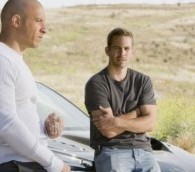 Publicity still via IGN
 When I listed Fast & Furious as one of my travel movies to watch for in 2009, I have to admit that my tongue might have been straying towards my cheek. I certainly never expected that the movie—the fourth installment in a fading franchise—would smash box office records and enjoy the biggest April weekend opening ever. But with an unexpected $70 million (and counting) in the bank, I suppose the movie qualifies as a phenomenon of sorts. With that in mind, I decided to check it out and see if there were any vicarious travel thrills to be had in between all the lingering shots of hot (auto) bodies.
Morning Links: Surviving Venice, Smelly Airport Advertising and More
by Eva Holland | 04.09.09 | 9:31 AM ET
Would You Take a Trip to TV Town?
by Sophia Dembling | 04.08.09 | 4:19 PM ET
 Photo by Sophia Dembling
 Truth or Consequences, New Mexico. It’s the only town in the world named for a TV show. In 1950, to celebrate the 10th anniversary of the show (which started on radio), the producers challenged a town to change its name to Truth or Consequences and the anniversary show would be taped there.
This southern New Mexico town, then called Hot Springs, voted overwhelmingly in favor of the change and from then on, its patron saint celebrity was host Ralph Edwards, who returned to the town many times until his death in 2005.
T or C has voted a couple of times since on whether it should return to its old name, but the TV name has stuck. After all, towns called Hot Springs are a dime a dozen.
World’s Poorest Countries Want Levy on Airline Tickets
by Joanna Kakissis | 04.08.09 | 2:16 PM ET
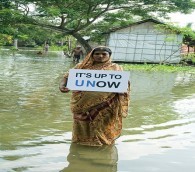
Rich nations produce most of the world’s CO2 emissions but poor countries often pay the price, suffering through worsening droughts, intense flooding, rising sea levels, crop failures and pollution. Sometimes, their citizens are forced to become economic refugees, and leave their homes altogether.
So in the name of climate justice, representatives of the world’s 49 poorest countries told negotiators at UN climate talks in Bonn that air passengers should each pay a $6 emissions levy per flight, The Guardian reports. This could raise about $10 billion a year that poor nations could use to help adapt to climate change.
Desert Solitaire: Inside an ‘Airplane Graveyard’
by Rob Verger | 04.08.09 | 12:54 PM ET

A sign that the airline industry is struggling in the poor economy: airlines are putting more planes into storage. “The number of planes in storage has jumped 29% in the past year to 2,302,” the AP reports.
Both this week’s AP story and a February 2006 New York Times story by Joe Sharkey take readers inside the Evergreen Maintenance Center in Arizona, with vivid descriptions of the rows of planes parked in the desert. Each article uses the word “ghost” or “ghosts” to describe the feeling of the motionless planes.
IHOP Hits 50 States: That’s a Lot of Pancakes
by Jenna Schnuer | 04.08.09 | 11:13 AM ET

While diners, taquerias, clam shacks, bbq shacks and waffle houses are the unofficial official dining establishments of Flyover America, IHOP deserves an honorable mention. There’s something to be said for the easy comfort of knowing exactly what you’re going to get and, Starbucks aside, no chain does it better than IHOP. It’s a nice thing when you’re on the road for a while (or, let’s be honest, slightly tanked after a night out).
As of the April 7 opening of its South Burlington, Vermont pancakery (our word, not theirs), IHOP is now open in each and every one of the 50 states. We raise our forks—loaded with a heaping helping of Rooty Tooty Fresh ‘N Fruity—in salute.
Empire State Building Goes Green
by Joanna Kakissis | 04.08.09 | 10:35 AM ET

The trendsters have spoken: Either you’re a greenvolutionary or you’re just another energy-sucking monument. So the Empire State Building, helped by $20 million from the Clinton Climate Initiative, aims to become the Art Deco landmark with a LEED rating, according to Reuters. The eco-makeover will include upgrading the building’s 6,500 windows and adding eco-friendly heating and air conditioning systems, insulation and energy-efficient lighting. The whole project is expected to cost about $100 million and is intended to cut energy consumption in the 102-story skyscraper by 38 percent.
