
Tag: Architecture
For Sale: Fabulous Hotel, Needs Work
by Sophia Dembling | 06.12.09 | 11:26 AM ET
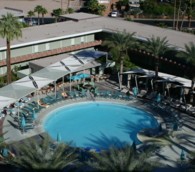 Photo by Sophia Dembling
 While we’re on the subject of kitsch, here’s a story about lottery winnings well-spent: After winning $49 million in the Texas state lottery, Byron and Barbara Woods bought the decrepit Tee Pee Motel in Wharton, Texas, about 50 miles from Houston, and made it crepit with a $1.6 million buff-‘n’-puff.
 Email to friend
 del.icio.us
 Digg
Digg Facebook
 Furl
Furl Ma.gnolia
 Mixx
Mixx Reddit
 StumbleUpon
 Yahoo! Buzz
24 Hours in Airworld: Terminal 5, Old and New
by Rob Verger | 06.09.09 | 3:11 PM ET
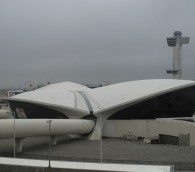
It was raining this morning in New York City as I made my way to J.F.K. to spend 24 hours hanging out in JetBlue’s Terminal 5. Every time I come to this airport, I’m reminded how far away it is from Manhattan. I took the 1 Train to the 2 Train to the E Train to the AirTrain to get here—a trip longer than some short flights.
On the elevated walkway from the AirTrain to T5, I was able to look out on the old Eero Saarinen TWA terminal—JetBlue’s new terminal sits in front of the beautiful, soaring old building, which is currently closed for renovations and is under the management of the Port Authority. Once it opens, JetBlue will have two self-service kiosks in there, and there’s a rumor that the building could one day become a museum—or a pod hotel. Today the building sat there closed, under gray skies, a landmark from another era, connected to the new building through the old tubes.
A Vertical Tour of Hong Kong
by Julia Ross | 04.20.09 | 10:14 AM ET
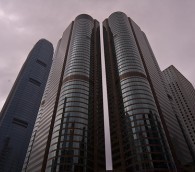
I read the current New Yorker profile of urban climber Alain Robert—aka “Spiderman”—expecting to learn the whys and wherefores of the Frenchman’s quirky obsession with scaling the world’s skyscrapers. There was plenty of that, but what surprised me was the extensive description of Hong Kong’s built environment, a kind of vertical canvas for Robert’s peculiar talent.
Writer Lauren Collins does a wonderful job describing how Hong Kong’s residents interact with their surroundings:
Read more of A Vertical Tour of Hong Kong »
Berlin, Germany: The Reichstag
by World Hum | 04.08.09 | 11:17 AM ET
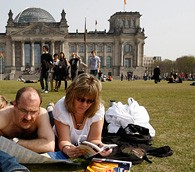 REUTERS/Fabrizio Bensch
 Tourists study a map in front of Berlin's Reichstag during a sunny spring day.
Empire State Building Goes Green
by Joanna Kakissis | 04.08.09 | 10:35 AM ET
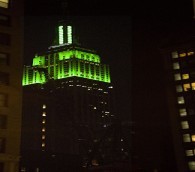
The trendsters have spoken: Either you’re a greenvolutionary or you’re just another energy-sucking monument. So the Empire State Building, helped by $20 million from the Clinton Climate Initiative, aims to become the Art Deco landmark with a LEED rating, according to Reuters. The eco-makeover will include upgrading the building’s 6,500 windows and adding eco-friendly heating and air conditioning systems, insulation and energy-efficient lighting. The whole project is expected to cost about $100 million and is intended to cut energy consumption in the 102-story skyscraper by 38 percent.
See This Now: Frank Lloyd Wright’s Fallingwater House
by Jim Benning | 04.02.09 | 12:16 PM ET

Will T.C. Boyle’s new novel, The Women, and Nancy Horan’s novel, Loving Frank—both about Frank Lloyd Wright and the women in his life—boost interest in Wright’s architecture and visits to the houses he designed? Perhaps, but Wright’s buildings are hardly hurting for visitors.
Wright’s Fallingwater house, which Time magazine declared his “most beautiful job” shortly after it was completed in 1937, has seen millions of visitors over the years. Located 50 miles from Pittsburgh, it’s worthy of adoration, spanning a waterfall and still somehow blending nearly seamlessly into the landscape. By all accounts, it was the inspiration for Ayn Rand’s The Fountainhead. The New Yorker once called it “Wright’s extraordinary essay in horizontal space.”
Filmed Here: ‘Men in Black’
by Eva Holland | 04.02.09 | 12:15 PM ET
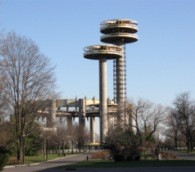 Photo by Eva Holland
 I celebrated the spring weather this week by heading out to Flushing Meadows Corona Park, aka “the Central Park of Queens,” for a wander in the sun. I didn’t know much about the park, beyond the name of the nearest subway station—so imagine my surprise when I walked through the gates and saw ... an extra-terrestrial spacecraft?
More precisely: what I saw was the observation tower of the now-abandoned New York State Pavilion (a relic from the World’s Fair), which served as a murderous alien’s would-be get-away vehicle in the climactic scene of the 1997 Will Smith flick, Men in Black. I’d seen the movie before, of course, but had never known where that final battle was set. Coming across the “space ship,” and the nearby Unisphere (which also plays a role in the battle), got me thinking about action movies and the major landmarks they use as props.
Morning Links: Japan’s ‘Ambassadors of Cute,’ Obama’s Position on Travel and More
by Michael Yessis | 03.13.09 | 8:06 AM ET
- Australia floats a plan to offer tourists free flights to the country, provided they spend a certain amount of money while visiting. (via Jaunted)
- IgoUgo lists 10 places to go to drink iconic drinks.
- Out: Sears Tower. In: Willis Tower.
- Airport living: A Finnish woman apparently spent more than two months calling Berlin’s Tegel airport home. (via Gridskipper)
- Japan unveils its “Ambassadors of Cute.” Metro has a photo.
- Kenya slashes visa fees to encourage more travelers to visit.
- The latest Washington Post Time Zones piece: Eating in Tehran with Thomas Erdbrink.
- The White House clarified President Obama’s position on travel: Travel on federal bailout money bad. A strong travel industry good.
- Finally, in the Onion TV listings: Crash Cab. Description: “In this hit game show, unsuspecting taxi passengers must answer general knowledge trivia questions correctly to prevent their cab from careening into the nearest storefront or bridge abutment.” (via @Marilyn_Res)
Got a suggestion? .(JavaScript must be enabled to view this email address) your link.
The Detroit Dilemma
by Sophia Dembling | 02.26.09 | 9:32 PM ET
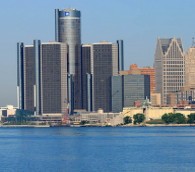
A number of years ago, I worked with a woman who was originally from Detroit. She loved her hometown and missed it terribly. I can’t remember her name, but I vividly remember the glow on her face when she talked about the city she’d left behind and to which she vowed to return someday.
I know, right? Hard to believe.
Yet Detroit has a draw, even if it’s a sort of pity vote. Friend and fellow writer Margaret Littman, also has a passion for the city. She says, “I love Detroit’s architecture and public art and wide boulevards. But more than that, I love that Detroit is such a microcosm of America: boomed thanks to ingenuity and innovative and now struggling with what to do next. Plus, I’m a sucker for an underdog.”
‘World’s Brainiest Tour Operator’ Now (Sort of) Affordable
by Eva Holland | 02.26.09 | 2:36 PM ET
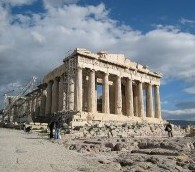
For all the high culture addicts out there, good news from Arthur Frommer: British tour operator Martin Randall Travel has been spotted advertising in Harper’s, which means, as Frommer writes, “that tours with profound intellectual content will henceforth be marketed to the American public; the ‘dumbing down’ of travel may be significantly slowed through this effort.” The guidebook mogul figures the shifting exchange rate, which has made Britain much more affordable for Americans in recent months, is behind the unprecedented stateside marketing effort. The tours still aren’t for shoestringers—the all-inclusive packages hover around 300 pounds per person per day—but, as Frommer notes, they’re cheaper than comparable college alumni tours, and thanks to the sliding pound they’re within easier reach than ever.
An Oil Rig Resort and Spa in the Gulf of Mexico?
by Joanna Kakissis | 02.19.09 | 4:29 PM ET

Morris Architects won the grand prize at the 2008 Radical Innovation in Hospitality awards by using an abandoned oil rig to design a luxury resort with more than 300 suites, a fancy restaurant and ballroom, a casino and “stargazer lounge,” and a rooftop infinity pool.
Could be a great idea, though oil companies are still hoping to explore the next petroleum frontier in the deep sea of the Gulf (and through five miles of rock, salt and packed sand). But if the United States ends up embracing Thomas Friedman’s energy technology revolution (as I hope!) and the oil-rig resorts catch on, I hope they don’t end up dumping their waste into waters already plagued by “red tide” algae blooms. Eco-resorts only, please. (via Treehugger and Jetson Green.)
No One Will Ever Find Me in This Camouflaged Treehouse Hotel
by Joanna Kakissis | 02.18.09 | 1:32 PM ET
Not sure if this idea is crazy or brilliant, but I’m not surprised that it came from eco-chic Scandinavia. The Swedish architecture firm Tham & Videgard Hansson have designed a lightweight treehouse hotel with a mirrored exterior that reflects the forest around it. The mirrored cube is supposed to be invisible, but with a full set of living quarters inside, including a bedroom, bathroom, kitchenette and even a roof terrace. (But a warning to the dainty eco-poseurs: scaling up here via rope ladder or rope bridge is not for the matched luggage set; pack a backpack instead.)
Standard Deviation
by Alexander Basek | 01.28.09 | 3:15 PM ET
Watching for the City Limits
by Emma Jacobs | 01.14.09 | 9:31 AM ET
 REUTERS/Jason Reed
 The sight of the New York City skyline used to transfix Emma Jacobs -- until routine dulled her senses.
Bird’s Nest or White Elephant?
by Julia Ross | 01.13.09 | 5:09 PM ET
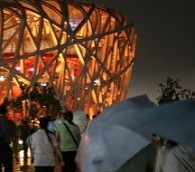
Say it ain’t so. A mere five months after the Beijing Olympic Games, has the Bird’s Nest stadium become a tourist trap? With no permanent tenant signed, that’s how it’s looking. I’m a big fan of the building and would happily pay the $7 fee to walk around inside, but at the same time hope the Chinese find a dedicated revenue stream to maintain it.
For a behind-the-scenes look at how the stadium was built, check out the documentary, Bird’s Nest: Herzog and de Meuron in China. The best parts are the unintentionally hilarious culture clashes between the building’s two “make-the-trains-run-on-time” Swiss architects and their Chinese partners. You can imagine.
The ‘Great Public Spaces’ of the World
by Eva Holland | 12.03.08 | 9:31 AM ET
The non-profit Project for Public Spaces has put together a list of the 60 greatest public spaces in the world—and they’ve gone about it using a pretty compelling definition of “public space.” “These are the places we remember most vividly,” says the PPS site, “the places where serendipitous things happen, the places we tell stories about. They are decidedly local, but can also absorb a fair amount of tourism without losing the qualities that make them great.”
Fair enough. So how about the winners? It’s an eclectic, far-ranging list. I found myself nodding in agreement with Venice’s Campo Santa Margherita, New York’s Grand Central Station, or the Ridge, in Shimla, India—and raising a puzzled eyebrow at the inclusion of the Corpus Christi bus terminal, or the main drag in Kuala Lumpur’s Chinatown. Over at Reid on Travel, Lonely Planet author Robert Reid offers up 10 spots that PPS missed. (Via Reid on Travel)
Architects and Mecca: Redesigning Islam’s Holiest Site
by Eva Holland | 12.01.08 | 1:36 PM ET
A shortlist of 18 possible architects has been drawn up for the daunting task of redesigning the mosque complex at Mecca, the Independent reports. Brits Norman Foster and Zaha Hadid are reportedly among the finalists. The planned redevelopment would more than triple capacity at the site, from the current 900,000 to a mind-boggling 3 million, making it the world’s highest-occupancy building.
The Ugliest Buildings in the World?
by Eva Holland | 11.26.08 | 9:37 AM ET
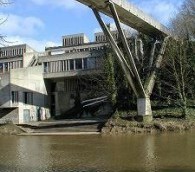
I’m guessing the folks at VirtualTourist.com had a lot of fun putting together this list of the world’s ugliest buildings and monuments. For my part, I enjoyed reading a “Worst of” list for a change, complete with acerbic commentary, instead of the glowing superlatives of the usual “Best of” lists. Here’s their take on New York City’s Port Authority Bus Terminal: “Those who pass by this iron monstrosity might be tempted to ask about a completion date, but alas, this is the finished product.”
As for the ugliest building I’ve encountered on my travels? The hands-down winner is Dunelm House, the students’ union building at Britain’s Durham University. It’s a prime example of Brutalist architecture, and its ugliness is only emphasized by its location: smack in the middle of an otherwise lovely medieval town.
‘Frozen Skyline’: Architecture and the Recession
by Eva Holland | 11.19.08 | 9:15 AM ET
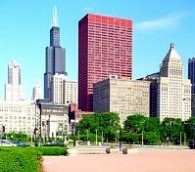
We noted a couple weeks back that a U2-Norman Foster project in Dublin has been put on hold thanks to the economic crisis. Now, a Frank Gehry development in the U.K. has gotten the axe, as well. “If Gehry can be tossed aside by recession-wary banks,” Jonathan Glancey asks in the Guardian, “what about less celebrated architects?” Glancey’s thoughtful essay speculates about the future of the architecture industry—and our skylines—through the recession, and after.
Plans for U2 Tower in Dublin ‘Shelved’
by Michael Yessis | 11.04.08 | 12:33 PM ET
All four members of U2 are invested in the Norman Foster-designed building, a planned 36-story tower on the banks of the River Liffey. If it ever gets built, it will be the tallest building in Ireland. Developers wanted to break ground this year, but now they’re waiting 12 months to see if the economic climate in Ireland improves. Bono and the Edge, however, still seem to be moving forward with their plans for the Clarence Hotel.